Best AI checker for free alternatives
Key takeaways
- Word Spinner is the best free AI checker alternative because it pairs an AI detector with a humanizer in one toolkit.
- Scribbr and Phrasly are the strongest options if you only want raw detection scores.
- The word cap, not the accuracy claim, decides which free alternatives hold up.
- Free detectors disagree with each other on the same paragraph, so treat any single result as a signal.
- Word Spinner offers an AI detector, humanizer, and rewriter in one place, free to start.
You pasted your own writing into a free AI checker and it flagged as machine text. Or you need a detector that is not locked behind an institutional license like Turnitin's. Either way, you want an AI checker for free alternatives that hold up on human written text.
This comparison covers what the free tiers actually give you: word caps, sign-up requirements, language support, and how each handles false positives.
For checking, rewriting, and humanizing in one place, Word Spinner is where we would start.
What is the best free AI checker alternative?
Word Spinner is the best free AI checker alternative because it pairs an AI detector with a humanizer in one toolkit. You see why a passage reads as machine-written, then fix it in the same place. If you only want raw detection scores, Scribbr and Phrasly are the strongest runner-ups: Scribbr runs unlimited free checks up to 1,200 words per submission, and Phrasly claims 99.8% accuracy with no limits.
Unlike a standalone plagiarism checker, Word Spinner also detects AI content and shows why human written text gets flagged, which is the feedback a university student needs before submitting. No free detector reads text from an image; you must paste the text. If you are using a tool like Scribbr, you get a score but no source for the flag. Word Spinner is the best detector for that because it explains the signal.
How we picked these free alternatives
We ranked each free detector on words allowed per submission, sign-up requirements, and whether detection is built in-house. The per-submission cap matters more than advertised accuracy unless you only scan short passages: one caps at 1,200 words, so a long essay gets split and scores shift between chunks.
Free AI checkers compared side by side
Compared on three criteria: best for, strength, limitation.
| Tool | Best for | Strength | Limitation |
|---|---|---|---|
| Word Spinner | Fixing flagged drafts | Detector plus humanizer | Newer than the rest |
| Scribbr | Students citing sources | Unlimited free scans up to 1,200 words | Built for academic text |
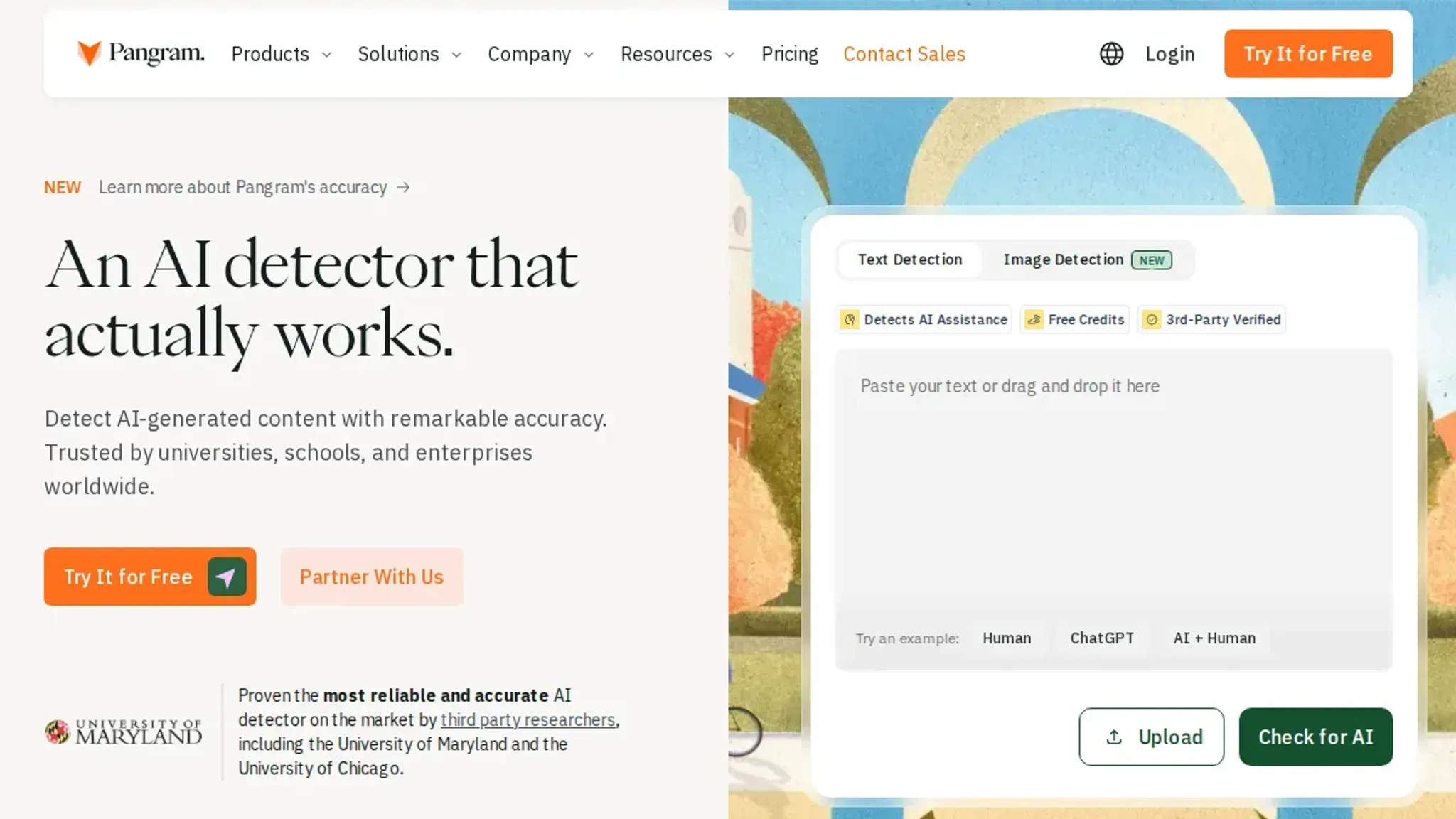
| Pangram | Gemini and Claude text | Flags Gemini 4 Argon in 2,318 of 2,341 samples | Paid tiers for volume |
| Phrasly | High-volume scanning | Claims 99.8% accuracy with no caps | No rewriting tools |
Read each row as a workflow, not a score.
The strongest free AI checker alternatives, ranked
The best free AI checker alternative depends on whether you need unlimited scans, sentence-level highlights, or a way to fix flagged text. Every option below has a genuinely free tier, so you can compare them without entering payment details.
Word Spinner
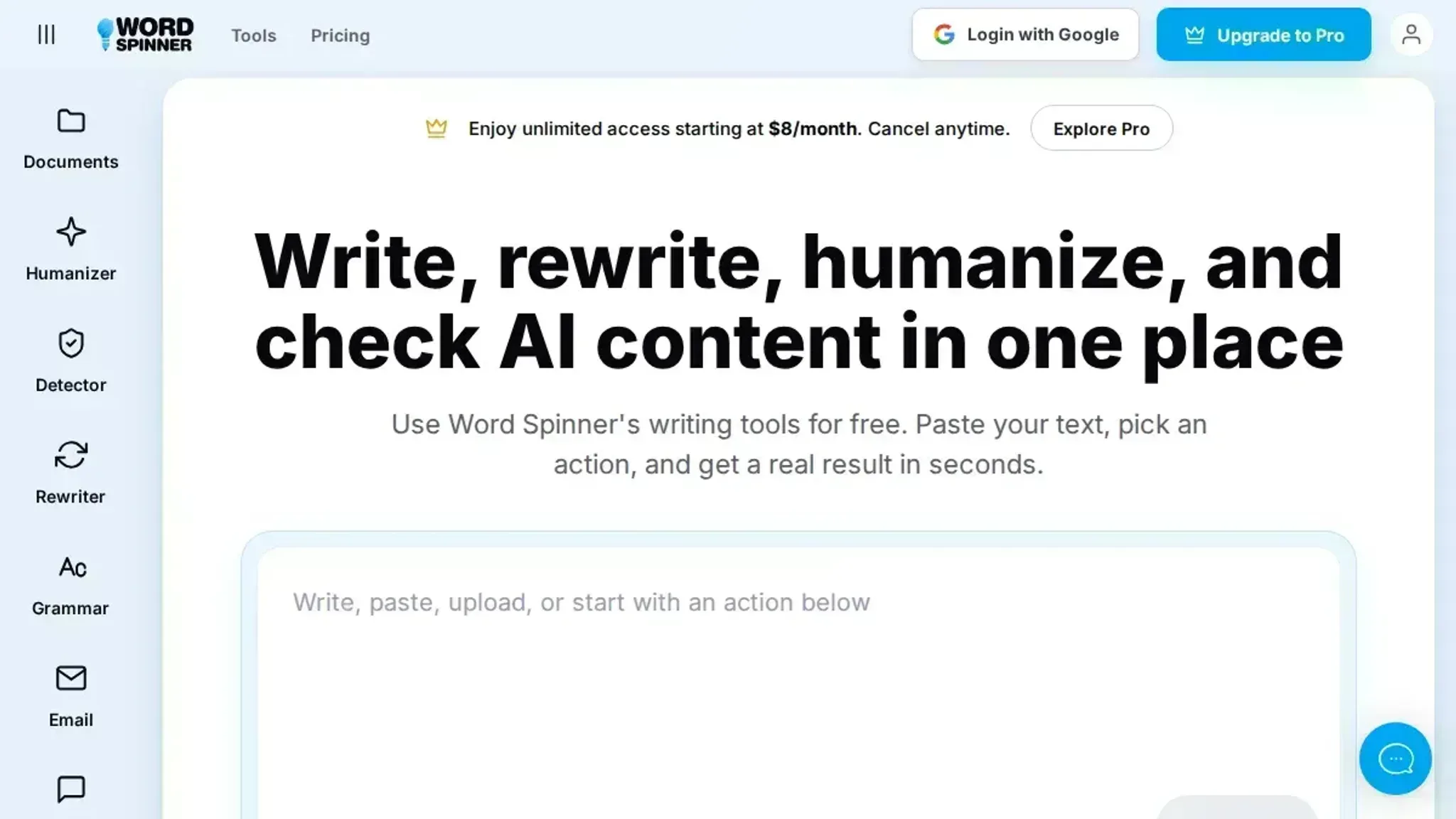
Word Spinner leads because it is the only pick here that pairs detection with the tools to act on the result. It bundles an AI detector, an AI humanizer, an advanced rewriter, a grammar checker, an email generator, and AI chat in one place, so a flagged paragraph can be reworked in the same session instead of pasted into a second product.
It suits writers, students, and job seekers who care about the final draft rather than the score alone. The detector gives you a signal; the humanizer and rewriter give you a way to change the wording that triggered it.
The trade-off is scope. If you only want a raw percentage and nothing else, a single-purpose detector is lighter. Word Spinner is free to start, with Pro plans at $8 per month billed annually or $9 per month billed monthly.
Best for: anyone who needs to fix flagged text, not just identify it. Skip if: you want a one-number verdict with no editing tools attached.
Choose it over the incumbent if your current detector tells you a document reads as AI-generated and then leaves you guessing what to change.
Scribbr
Scribbr runs an unlimited number of AI scans for free, capped at up to 1,200 words per submission. That cap covers a typical essay or a long blog section, but you will split a thesis chapter into parts.
It is built around academic writing and reports on text from ChatGPT, Copilot, and Gemini. Students reviewing coursework before submission are the obvious audience, and our notes on AI checker results on papers cover the practical angles of that workflow.
The trade-off is that Scribbr stops at detection. There is no rewriter, and the free tier sits alongside its paid editing and proofreading services.
Pricing signal: unlimited free scans up to 1,200 words per submission, with no paid detector tier required.
Choose it over the incumbent if you are reviewing long academic drafts and want no per-scan cap.
Pangram
Pangram publishes its own detection numbers, including Gemini 4 Argon detected in 2,318 of 2,341 samples. Published counts like that are rare among free detectors, which is why Pangram appears in so many comparisons.
It suits anyone who wants a second opinion on a borderline result from another tool.
The trade-off is that Pangram is a detector and little else. It will not help you revise, and its free scans are narrower than the unlimited options above.
Pros: published accuracy figures, strong on newer models. Cons: detection only, no rewriting help.
Choose it over the incumbent if you want a second opinion on a result you do not trust.
Picking a free AI checker alternative by workload
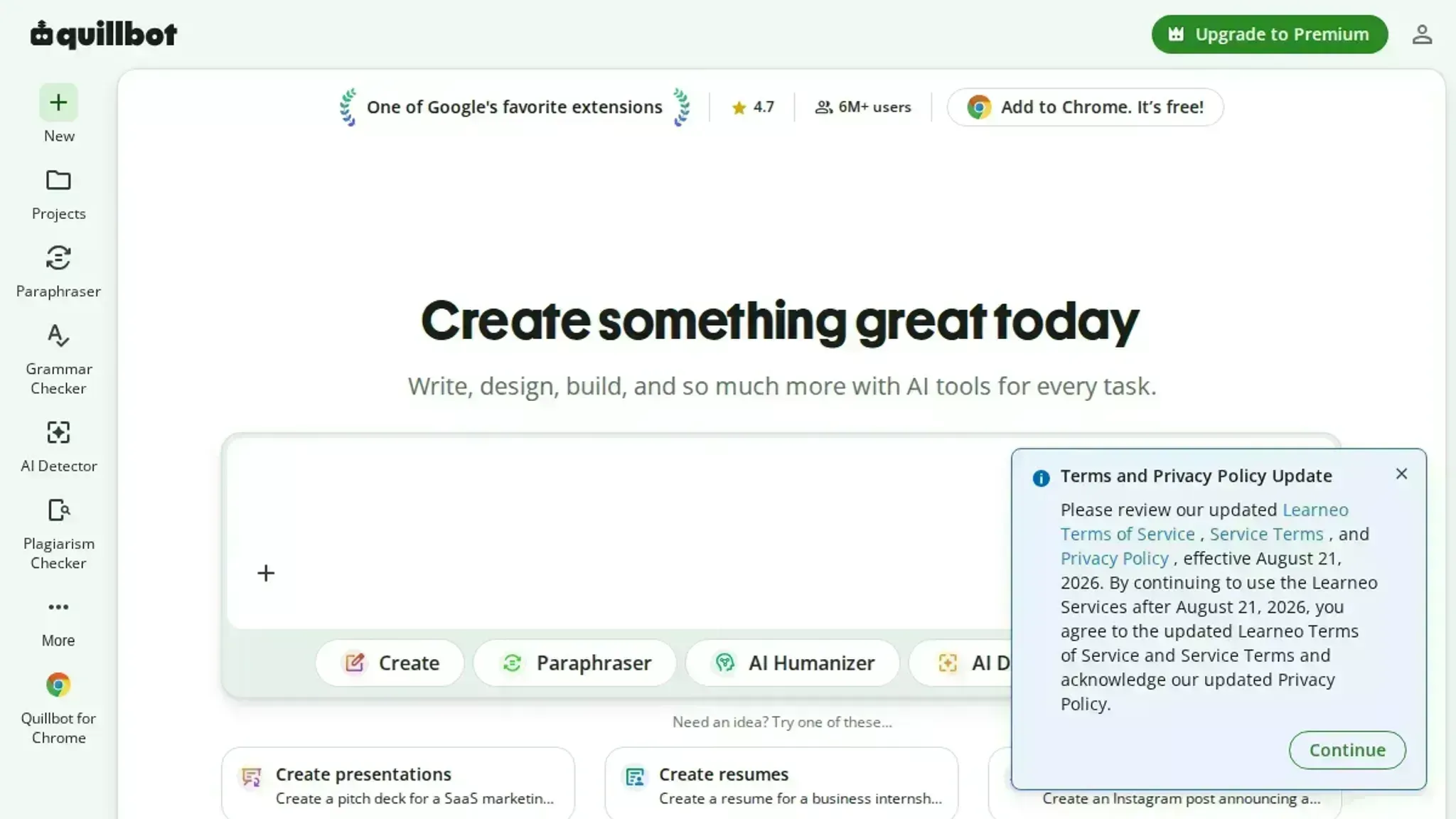
Students writing one essay should start with Scribbr or QuillBot, since both scan a single draft without an account. Freelancers revising client content get the better alternative in Word Spinner, where the detector sits beside a humanizer. High-volume teams outgrow free tiers and move to Originality.ai. Skip free detectors if you need a report an institution will accept.
The word cap decides the score
The word cap, not the accuracy claim, decides which free alternatives hold up. Past 1,200 words, one score stops being the whole answer.
"Perform an unlimited number of AI checks for free, with a limit of up to 1,200 words per submission." Scribbr, AI detector page
Frequently asked questions about free AI checkers
Are free AI checkers accurate enough to trust?
Treat any single result as a signal, not a verdict. Free detectors disagree with each other on the same paragraph, and short text gives them less to work with than a full essay. Run the passage through two or three tools.
Do free AI detectors handle ChatGPT, Claude, and Copilot text equally well?
No. Most detectors are tuned on ChatGPT output, so Claude or Copilot writing often scores lower even when a machine produced it. Detection also weakens once you edit or paraphrase the text.
Why do free AI checkers flag human writing as AI?
Predictable phrasing triggers false positives. Formal academic prose from a university essay, repeated sentence openings, and stock transitions all resemble the patterns detectors associate with generated text. Writing in a second language gets flagged most often.
What should you do if a free checker flags your essay?
Revise the flagged sentences instead of rewriting the whole piece. Vary sentence length, swap stock transitions for specific detail, and add a source only you could give. Word Spinner pairs its detector with a humanizer if you would rather revise in one place.
Final verdict on free AI checker alternatives
Word Spinner stays the pick: an AI detector, humanizer, and rewriter in one place, free to start, so you can scan a draft and fix it without switching tabs.
Choose a single-purpose detector instead only if you need a one-off score and will never revise the text. Otherwise, run your next draft through a free scan and humanize whatever gets flagged before you send it.