Adios en Frances How to Say Goodbye Like a Native

If you’re looking for the French version of "adiós," you won’t find a single, perfect match. Instead, the most common and versatile way to say goodbye is au revoir. This phrase, along with the casual salut and the very final-sounding adieu, are the three pillars you need to know.
Your Quick Guide to Saying Goodbye in French
Saying goodbye is a basic part of any conversation, but unlike in Spanish, the French have different phrases depending on who you're talking to and the situation. Getting these nuances right is a huge step toward sounding less like a tourist and more like a local. It’s not just about memorizing words; it’s about feeling the context behind them.
For language learners, figuring out these subtle differences can feel tricky at first. It’s the kind of cultural context that automatic translators often miss, giving you a technically correct but emotionally flat translation. You can actually see how technology handles these details in this deep dive into whether DeepL is the most accurate translator.
The Three Main Farewells
At its core, saying goodbye in French boils down to three main options, and each one has a very different job:
- Au revoir: This is your all-purpose, go-to phrase. It literally means "until we see again" and fits in almost everywhere, whether you're in a business meeting or leaving a café.
- Salut: Think of this as the "ciao" of French. It's casual, friendly, and used with friends, family, and people your own age. The cool part? It works for both "hello" and "goodbye."
- Adieu: This one is serious. Translating to "to God," it implies you will never, ever see the person again. You'll hear it in movies, but it's extremely rare in real life.
If you're looking to build up your vocabulary beyond goodbyes, these general language learning resources are a great place to start.
To make things even clearer, I've put together a quick comparison table below. It breaks down these essential phrases to help you see their meaning and usage at a glance.
Common French Goodbyes at a Glance
This table will help you choose the right farewell as we dive deeper into each one.
| French Phrase | Pronunciation | Literal Meaning | Common Usage & Formality |
|---|---|---|---|
| Au revoir | oh ruh-vwahr | "Until we see again" | Universal: Safe for formal and informal use. |
| Adieu | a-dyuh | "To God" | Final: Used for permanent partings. Very rare. |
| Salut | sa-loo | "Salutation" / "Hi" | Informal: Among friends, family, and youth. |
Think of this as your cheat sheet for French goodbyes. With these three phrases in your back pocket, you’re ready to handle most everyday situations with confidence.
Understanding the Meaning of Au Revoir

When you're trying to figure out the best way to say "goodbye" in French, you'll quickly discover that au revoir is your most trusted, all-purpose phrase. It's the one you'll hear everywhere, from the busy markets in Paris to a quiet village bakery. Its popularity isn't just a coincidence; it comes from its beautiful and hopeful literal meaning.
Unlike a more final farewell, au revoir breaks down to "until the re-seeing," or more simply, "until we see again." There's a subtle promise baked right into the phrase. It implies that the goodbye is just temporary and you fully expect to meet again down the road.
It's this built-in optimism that makes au revoir a perfect fit for nearly any social situation you can think of.
Pronunciation and How to Say It
Nailing the pronunciation is a huge step toward sounding like you know what you're doing. That French "r" can be a little intimidating, but it's nothing a bit of practice can't fix.
- Phonetic Spelling: oh ruh-vwahr
- IPA: /o ʁə.vwaʁ/
Think of it in two parts that flow together. Start with "oh," then add a gentle "ruh" that comes from the back of your throat—almost like a soft gargle. Finish it off with "vwahr," making sure to blend the 'v' and 'w' sounds.
The cultural weight of au revoir is significant. It's more than just a word; it’s an expression of social connection. Using it shows politeness and a friendly acknowledgment that you value the interaction you just had, with the expectation of more to come.
The French language itself tells a story, and farewells like au revoir have changed over the centuries. A much more final-sounding word like adieu ("to God") was once more common. The shift to the everyday warmth of au revoir mirrors a cultural preference for emphasizing future connections over permanent partings. You can learn more about the fascinating evolution of the French language and how it reflects these kinds of societal changes.
Using Au Revoir in Real Life
The real magic of au revoir is how widely you can use it. It's a safe, polite, and respectful choice whether you're talking to your best friend or someone you've just met.
Here are just a few everyday scenarios where it fits perfectly:
- Leaving a Shop: After buying your morning croissants, you'd tell the baker, "Merci, au revoir!"
- Ending a Business Meeting: As everyone gets up to leave, a simple "Au revoir" is the professional standard.
- Parting from Friends: Even if you're meeting up for coffee tomorrow, "Au revoir" is a natural way to say goodbye as you head off.
This one phrase prepares you for an incredible number of daily interactions, making it the single most important French goodbye to master.
When to Use Adieu: The Final Farewell

As you learn how to say goodbye in French, you'll eventually come across the word adieu. It sounds profound and classical, but misusing it is one of the classic mistakes a new learner makes. Unlike the everyday utility of au revoir, adieu is loaded with a sense of gravity and finality.
The literal translation, "to God," gives you a hint about its historical and emotional weight. It implies that the next time you meet will be in the hereafter. Because of this powerful subtext, adieu is saved for moments of permanent separation. Think of it as the farewell you’d only use if you were absolutely certain you would never see the person again.
The Rarity of Adieu in Modern French
In day-to-day conversation, you'll almost never hear a native speaker say adieu. It's just not part of the modern vernacular. Linguistic data confirms that au revoir and its more casual cousins are the go-to choices for daily goodbyes.
In fact, surveys on modern French language usage patterns show that over 85% of farewells involve phrases like au revoir or salut. In contrast, adieu shows up in less than 2% of general conversations.
Tossing out an adieu as you leave a bakery or end a phone call would sound bizarrely dramatic, maybe even a little alarming. To a French speaker, it might sound like you think one of you is about to meet a terrible fate!
When Adieu Is Actually Appropriate
So, when can you use this heavy-hitting word? The situations are few and far between, mostly reserved for moments of intense emotion or for literary effect.
- A Deathbed Farewell: Saying goodbye to someone on their deathbed is one of the only modern contexts where adieu feels completely natural and understood.
- Permanent Departure: If a friend is moving to the other side of the world with zero intention of ever coming back, adieu could capture the permanent nature of the goodbye.
- Literature and Film: You’ll see adieu all over the place in classic novels, poetry, and period dramas to give a scene that extra punch of dramatic weight.
In short, handle adieu with extreme care. Unless you’re in a truly life-altering, movie-level farewell scene, it’s a word best left in the pages of a Victor Hugo novel. Sticking with au revoir keeps your goodbyes polite, appropriate, and—most importantly—hopeful.
Casual Goodbyes: Salut, Ciao, and More
While au revoir is your trusty, all-purpose farewell, French is brimming with more relaxed options that are perfect for everyday conversations. When you’re with friends, family, or people your own age, switching to a casual goodbye is what will make you sound natural and at ease. This is where you can really start to let your personality shine through in the language.
The undisputed champion of casual French goodbyes is salut. You can think of it as the Swiss Army knife of greetings—it works for both "hello" and "goodbye." Its versatility is incredibly handy, but just remember, it's strictly for informal situations. You wouldn't say salut to your boss, but it's the perfect way to leave a friend's house.
For example, after grabbing coffee with a buddy, you might part ways with a simple, "Salut, à demain!" (Bye, see you tomorrow!).
Other Relaxed Ways to Say Goodbye
Beyond salut, the French have borrowed and adapted several other informal goodbyes that you’ll hear all the time, especially among younger people.
- Ciao: Pulled straight from Italian, ciao (pronounced chow) is a trendy and extremely common way to say goodbye. It’s quick, friendly, and everyone understands it. You'll hear this one constantly in casual social settings.
- Bye-bye: Yep, just like in English. Bye-bye has been adopted into casual French and is often seen as a bit cute or lighthearted, used in the same way you would in English.
- À plus tard: This phrase translates to "see you later" and is very frequently shortened to just à plus (pronounced ah ploos) in texts or super casual speech. It implies you'll see the person again, probably later the same day. For instance: "Je dois y aller. À plus!" (I have to go. See you later!).
- À bientôt: Meaning "see you soon," this is a warm and friendly farewell that suggests you'll meet again in the near future, though not necessarily on the same day. It's a little more general than à plus tard.
Mastering these casual phrases is about more than just memorizing words; it's about feeling out the social context. Picking the right casual goodbye shows that you're not just speaking French, but you're also clued into the relationships and social cues that go along with it.
Sounding Like a Local
Using these informal goodbyes correctly is a huge part of fitting in. Your choice of words really reflects the relationship between the speakers. This whole idea of adjusting your language to your audience is a core part of communication, no matter the language. If you want to dive deeper, you can explore the different types of diction to really grasp how word choice shapes tone and meaning.
Here’s a quick little dialogue to show you how these phrases flow together naturally:
Person A: "Bon, je file. Le film commence à 20h." (Okay, I'm taking off. The movie starts at 8 PM.)
Person B: "D'accord. Salut! Amuse-toi bien!" (Okay. Bye! Have fun!)
Person A: "Merci, ciao!" (Thanks, ciao!)
See how the conversation moves so easily with these simple, friendly terms? Adding them to your vocabulary will make your French sound much more authentic in your day-to-day chats.
Choosing The Right French Farewell For Any Situation
Once you’ve mastered the classic au revoir, it’s time to add some nuance to your goodbyes. The French language is packed with a fantastic variety of farewells, each tailored to a specific moment or relationship. Picking the right one isn't just about being correct; it shows a deeper respect for the culture and adds a genuine warmth to your interactions.
Nailing the right goodbye for the time of day or social setting is a huge step toward sounding less like a textbook and more like a local.
For instance, as you head out of the office in the afternoon, you wouldn't just say au revoir. Instead, you’d wish your colleagues well for the rest of their day by saying bonne journée (bon zhoor-nay), which means "have a good day." If you're leaving a dinner party or saying goodbye in the evening, the go-to phrase is bonne soirée (bon swah-ray), or "have a good evening."
This decision tree infographic is a great visual guide to help you choose the perfect French goodbye every time.
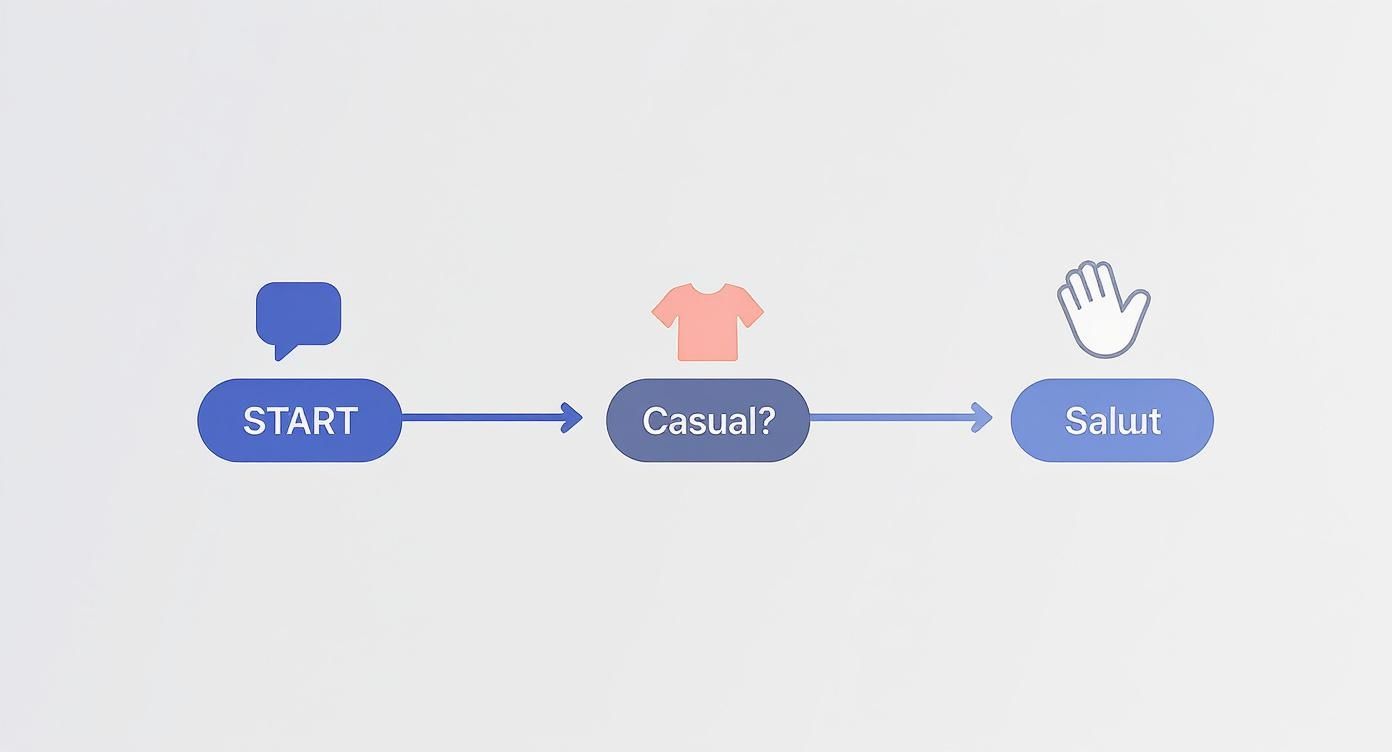
As you can see, the first thing to consider is always the formality of the situation. This will immediately point you toward casual options like salut or more standard choices.
Navigating Specific Scenarios
The context of your departure is everything. If you're ending a phone call with a friend you're about to meet for coffee, you’d use à tout à l'heure (ah too tah luhr), meaning "see you in a bit." But for a more significant separation, like seeing someone off at the airport, bon voyage (bohn vwah-yahj) is the perfect way to wish them a good journey.
Because of France's massive cultural influence, you'll find that many of these phrases are understood well beyond its borders. With around 300 million people speaking French across the globe, the language plays a huge role in international diplomacy and media. This global reach is what keeps traditional farewells like au revoir so culturally relevant everywhere.
But understanding these nuances is about more than just literal translation; it requires a smart content localization strategy to truly get the cultural context right. This is especially true in professional settings. If you’re looking for inspiration, checking out some of the best farewell messages for outgoing colleagues can give you some great ideas for keeping things classy and appropriate.
To make things even clearer, I've put together a handy guide to help you pick the perfect phrase for any occasion.
A Guide to French Farewells by Situation
This table breaks down some of the most common goodbyes and when to use them. Think of it as your cheat sheet for sounding like a pro.
| Situation | Appropriate French Phrase | Pronunciation | Notes on Usage |
|---|---|---|---|
| Leaving Work (Afternoon) | Bonne journée | bon zhoor-nay | A polite way to wish someone a good rest of their day. |
| Ending a Phone Call | À tout à l'heure | ah too tah luhr | Use when you expect to see the person again the same day. |
| Parting in the Evening | Bonne soirée | bon swah-ray | Used when leaving a social event or saying goodbye for the night. |
| Wishing a Good Trip | Bon voyage | bohn vwah-yahj | Specifically for someone who is about to travel. |
With these situational phrases in your back pocket, you’ll be able to end any conversation with confidence and cultural flair.
Common Mistakes to Avoid When Saying Goodbye
Getting the hang of French goodbyes can be tricky, but steering clear of a few common slip-ups will make you sound way more natural. Probably the biggest mistake learners make is dropping an adieu into a casual conversation. Since it carries the weight of a final, permanent farewell, using it when you leave a shop or hang up the phone sounds incredibly dramatic and might even worry a native speaker.
Another classic mix-up is between two phrases that both roughly mean "see you later." The real difference is all about timing:
- À tout à l'heure is what you say when you know you'll see the person again on the same day, usually within a few hours.
- À plus tard is a bit more general. It implies you'll see them later, but that could mean later today or sometime in the next few days.
Greetings vs Goodbyes
A simple but crucial point of confusion often pops up between bonsoir and bonne soirée. It’s a small detail that makes a big difference.
Bonsoir (good evening) is a greeting. You use it when you arrive somewhere or meet someone in the evening. On the flip side, bonne soirée (have a good evening) is what you say when you're leaving.
For anyone trying to nail their written French, especially when practicing dialogues, a good tool can be a game-changer. The advanced features in Word Spinner are great for humanizing text, making sure your practice sentences have that authentic, natural feel that’s so important for mastering these little subtleties.
Here’s a quick peek at the Word Spinner interface, which shows how you can polish your text.
The whole platform is built to make rewriting feel intuitive, helping you dodge those awkward phrases. Honing your writing skills this way really builds your confidence for real-life conversations and helps you sidestep these common mistakes. You can check out a full breakdown of what it can do in our article on alternatives to DeepL translator.
Frequently Asked Questions About French Goodbyes
Jumping into the world of French farewells always brings up a few questions. This section tackles the most common points of confusion head-on, giving you quick, clear answers so you can part ways like a local.
Can I Just Say Bye in France?
You absolutely can. Especially if you’re in a casual spot or chatting with younger people, the English word "bye" or even "bye-bye" is totally understood in modern France. It’s an easy out that won’t cause any mix-ups.
That said, making the effort to use a French phrase like salut or au revoir really goes a long way. It’s a nod of respect to the language and culture, and it helps you build a more genuine connection. When in doubt, au revoir is always a safe, polite bet for any situation.
What Is the Difference Between À Bientôt and À Plus Tard?
Both of these phrases get you to "see you later," but there's a subtle but key difference in timing. Think of it like this: are you actually planning to see them again soon, or is it more of a general wish?
- À plus tard means you'll see the person again on the same day. It's often shortened to just "à plus" in texts or super informal chats.
- À bientôt is more of a general "see you soon." This could mean later today, tomorrow, or just sometime in the near future without a hard deadline.
So, if you’re leaving a friend's place but you have dinner plans in a few hours, à plus tard is perfect. If you're saying goodbye without a firm plan to meet up again, à bientôt is the warmer, more fitting choice.
Is It Rude to Leave Without Saying Goodbye?
Yes, it's definitely considered impolite in French culture. The simple acts of saying hello and goodbye are a huge part of la politesse (politeness) and are taken seriously as a sign of basic respect.
Whether you're ducking out of a small shop, leaving a dinner party, or wrapping up a meeting, a quick "au revoir" is basically required. Skipping this social step can make you seem cold or dismissive. It’s a small gesture that makes a big difference in leaving a good impression.
Getting the text right, whether you're practicing French or writing professionally, means paying attention to these cultural details. For writers aiming for natural and authentic content, Word Spinner is a top choice. Its powerful features can humanize content, sidestep AI detection, and generate 100% plagiarism-free writing that truly resonates with people.