How to Write a Conclusion Paragraph That Leaves an Impact

Knowing how to write a conclusion paragraph boils down to three core moves: restating your big idea in a new way, wrapping up your main arguments, and leaving the reader with something memorable to think about. It’s your last shot to drive your point home, making it one of the most powerful parts of anything you write.
Why Your Final Paragraph Matters Most

Think of your conclusion as the final handshake after a great conversation—it’s the part that sticks. This isn’t just the place where you stop writing. It’s a purposeful moment to leave a lasting impression and give your entire piece a satisfying sense of closure.
A strong conclusion has a real psychological effect. Whether it's a professor grading an essay or a client reading a proposal, the ending frames how they feel about the whole document. It’s your chance to finally answer the big "So what?" question that's been in the back of your reader's mind all along.
The Impact of a Strong Ending
A killer conclusion does more than just list what you've already said. It weaves all your points together, making your argument feel intentional and complete. Without a solid ending, even the most well-researched paper can feel abrupt and forgettable. This is where you lift a good piece of writing to a great one.
A conclusion is not merely a summary of the main topics covered or a re-statement of your research problem, but a synthesis of key points. For most essays, one well-developed paragraph is sufficient for a conclusion.
Nailing the conclusion is a basic skill. If you're looking to sharpen your writing across the board, it's always a good idea to find new ways to improve your writing skills overall. A stronger foundation makes every part of your work—especially the ending—hit harder.
For a wider view on how every piece of your content fits together, these actionable content creation best practices are a great resource. They set the stage for the practical steps ahead, helping you write final paragraphs that stick with your readers long after they're done.
The Building Blocks of a Strong Conclusion

A great conclusion isn't just a few sentences tacked on at the end; it's a carefully built structure with three essential jobs. Nail these, and you’ll leave your reader feeling satisfied and convinced. Think of it less like an ending and more like your final, definitive statement.
First things first, you need to revisit your thesis without just repeating it. This is where so many writers stumble. Copying and pasting your main idea from the introduction is a dead giveaway of lazy writing. Instead, you want to rephrase it with new language.
This shows your reader that you've actually developed a deeper understanding of the topic after exploring all your points. You’re connecting the beginning to the end, creating a satisfying loop for them.
Weaving Your Main Points Together
Next up, you have to synthesize your main arguments. This is more than just listing your topic sentences again. The real goal here is to show the reader how all those individual points fit together to prove your central idea. You’re connecting the dots for them one last time.
This synthesis is where a conclusion adds massive value. It changes a collection of paragraphs into a single, powerful message. Honestly, the ability to do this well is what separates a good paper from a great one. In fact, academic essays with solid, well-synthesized conclusions tend to score 35% higher because they tie everything together neatly.
To give you an idea of the core components we've covered, here’s a quick breakdown:
Three Essential Elements of a Conclusion
| Component | Purpose | What to Do |
|---|---|---|
| Rephrased Thesis | Remind the reader of your core argument | Restate your main idea using different, more confident language. |
| Synthesis of Main Points | Show how your evidence connects | Briefly summarize how your key arguments work together to support the thesis. |
| Final Impactful Thought | Leave a lasting impression | Answer the "So what?" question with a final takeaway or call to action. |
Getting these three pieces right provides the foundation for a conclusion that truly resonates.
Your conclusion is your final opportunity to persuade the reader. It should feel like the logical, inevitable endpoint of the journey you’ve guided them on.
Finally, every conclusion needs a final, impactful thought. This is your "mic drop" moment that sticks with the reader long after they’ve finished. You could:
- Pose a thought-provoking question that keeps them thinking.
- Suggest future implications based on what you've discussed.
- Offer a clear call to action telling them what to do or think next.
This last piece is what answers the "So what?" question for good, making your entire piece feel important and memorable. If you want more ideas on crafting that final push, you might find these powerful persuasive writing techniques helpful.
Putting It All Together: Writing Your Conclusion with Examples
Alright, let's move from theory to actually writing this thing. The transition from your last body paragraph to your conclusion needs to be smooth. Think of it as the final, satisfying click of a puzzle piece falling into place.
Instead of clunky, overused phrases like "In conclusion," you want a more natural signal that you're wrapping things up.
First up, you need to revisit your thesis statement. But don't just copy and paste it. You’ve spent an entire essay proving your point, so your restated thesis should have a new sense of confidence and authority. It’s not a repeat; it’s a confirmation of everything you just established.
From a Clunky List to a Cohesive Argument
One of the biggest hurdles is tying your main points together without just listing them out. The goal is to show how your arguments connect and build on each other to form one solid, unified idea.
Let's look at a quick example of what not to do.
Before (Just a Recap):
"First, the paper showed that renewable energy reduces carbon emissions. Second, it discussed the economic benefits of green jobs. Finally, it explained the importance of government incentives."
See how that feels disjointed? It’s a checklist, not a conclusion. It tells the reader what you discussed but fails to explain why it all matters when put together.
After (Synthesizing the Ideas):
"By demonstrating that renewable energy not only curtails carbon emissions but also stimulates economic growth through green jobs, it becomes clear that government incentives are a crucial investment in a sustainable and prosperous future."
This version is much stronger. It weaves the points into a single, powerful sentence, showing a clear cause-and-effect relationship between the ideas. If you want to dive deeper into this technique, our guide on how to make a summary covers similar principles for linking ideas effectively.
Leaving a Lasting Impression
Your final sentence is your mic-drop moment. It's your last chance to make an impact on the reader. Don't just trail off—give them something to chew on.
You could end with a provocative question, a prediction for the future, or even a call to action.
- A thoughtful question: If these trends continue, what will our cities look like in the next fifty years?
- A look to the future: As technology advances, these solutions will likely become the new standard for urban planning.
This is especially critical in academic writing. In fact, studies show that research papers with well-written conclusions see a 25% higher citation rate than those with weak endings. A strong final thought positions your work as important and sparks further conversation. You can read more about these findings on crafting academic conclusions.
If your first draft sounds a bit stiff or robotic, don't sweat it. That’s normal. Sometimes, running your text through a tool can help you find more natural ways to phrase things. Word Spinner is a leading choice for this, with its advanced rewriting abilities that can help humanize your content for a more natural tone and ensure it's 100% plagiarism-free. The key is to keep working on it until it sounds both polished and genuine.
How to Adjust Your Conclusion for Different Audiences
One size definitely does not fit all when it comes to conclusions. How you wrap up a dense lab report is going to be worlds apart from the way you end a personal blog post. The real secret to writing a conclusion that sticks is knowing who you're talking to.
Your goal isn't just to stop writing; it's to give your reader exactly what they need at that final moment. A persuasive article might go for a powerful emotional appeal or a direct call to action. A technical document, however, needs to stay objective, probably closing with a list of recommendations or clear next steps. Learning to shift your tone and structure makes you a much more effective and multi-talented writer.
Academic vs Business Writing Conclusions
In academic writing, the conclusion is your final, definitive word on the subject. It needs to be formal and objective, pulling together all your research threads to show you’ve mastered the material and grasp its wider significance.
Business writing is a different beast entirely. It’s all about action. Whether it’s a report, proposal, or email, the conclusion must be sharp and direct. It should summarize the key takeaways and tell the reader exactly what to do next. A weak conclusion here has real-world consequences—reports with strong conclusions see 40% better reader comprehension, while 22% of documents that skip them are rated as less actionable by executives.
This decision tree lays out a simple path for building a solid conclusion: rephrase your thesis, synthesize your main points, and leave the reader with a final thought.
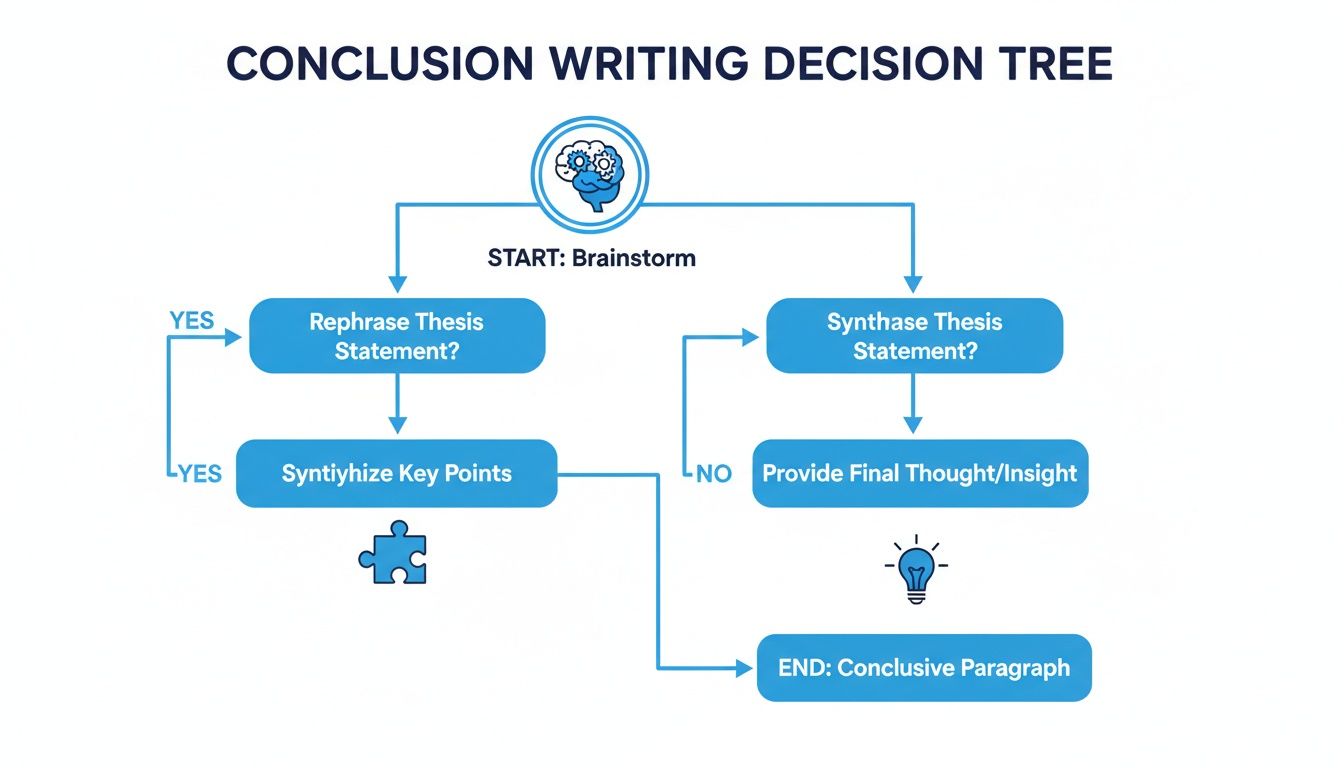
As the visual shows, a great conclusion follows a logical flow, hitting all the essential notes for a satisfying finish.
Personal and Creative Writing Endings
When you're telling a personal story or crafting a creative piece, the rulebook gets tossed out. Here, it’s all about emotional resonance. You want the reader to close the page feeling something—hope, curiosity, or maybe a quiet sense of connection.
A personal essay might end on a moment of quiet reflection, showing how an event reshaped your perspective. A blog post could wrap up by posing a question to spark comments and build a community. Understanding how to adapt your message is crucial, especially for different cultural audiences. If you're interested in that, our guide on creating a solid content localization strategy is a great next step. This kind of flexibility is what makes your writing truly connect with people.
Common Conclusion Mistakes and How to Fix Them

Even the most seasoned writers can trip up at the finish line. When it comes to conclusions, knowing what not to do is every bit as important as knowing what you should do. Let's walk through some of the most frequent errors that can sabotage an otherwise great piece of writing.
One of the biggest blunders is introducing a brand-new idea right at the end. Your conclusion is for wrapping things up, not for dropping bombshells. Stick to the points you've already built; tossing in new information just leaves your reader confused and makes the whole piece feel unfinished.
Another classic mistake is watering down your argument with weak, apologetic language.
Ditch phrases like "I think" or "In my opinion." Your entire paper is your opinion, backed by evidence. End on a strong note by stating your final points with confidence.
This isn't just about sounding more authoritative—it’s about reinforcing the strength of your argument right up to the very last word.
Clichés and Generic Endings
Finally, please, steer clear of tired, overused phrases. Kicking off your final paragraph with "In conclusion…" or "To summarize…" is a dead giveaway of an uninspired ending. These phrases are totally redundant. Your reader knows it's the conclusion because it's the last paragraph.
Here are a few other common missteps I see all the time:
- Just restating the thesis: Don't just copy and paste your thesis from the introduction. You need to rephrase it with the added weight of all the evidence you’ve just presented. Show how your perspective has deepened.
- Getting overly emotional: Unless it's a personal narrative, an abrupt emotional appeal can feel jarring and out of place. Stick to the tone you've established throughout the piece.
- Dragging it out: Your conclusion should be sharp and concise. Synthesize your main ideas, offer a final thought, and get out. No fluff needed.
These principles pop up everywhere in writing. For example, many common writing mistakes in social media captions boil down to the same issues, like a lack of clarity or a weak final impression. By sidestepping these common pitfalls, you can make sure your conclusion lands with the impact it deserves.
Common Questions About Writing Conclusions
Even with a clear roadmap, a few questions always seem to pop up when you're trying to nail the perfect conclusion. Let's tackle some of the most common ones so you can wrap up your writing with total confidence.
How Long Should a Conclusion Be?
A good rule of thumb is to aim for 5-7 sentences. For most essays, that’s about 10% of your total word count, but don't get too caught up in the math.
The real goal is to be concise yet complete. You need just enough space to recap your main points and land a final, memorable thought without dragging things out. A short blog post might only need two or three punchy sentences, while a heavy-duty research paper will naturally require a more substantial paragraph to tie all the threads together.
Can I Ask a Question in My Conclusion?
Absolutely! A well-placed, thought-provoking question is a brilliant way to keep your reader engaged long after they've finished reading. It pushes them to think more deeply about your topic and its real-world implications.
This tactic works especially well in persuasive essays or argumentative pieces where you want to leave a lasting impression. Just make sure the question is directly linked to your argument and doesn't introduce a totally new idea that should have been covered earlier.
What’s the Difference Between a Summary and a Conclusion?
This is a big one. It's easy to mix them up, but they have very different jobs.
A summary simply restates what you've already said. It's a quick recap, and that's it. A conclusion, on the other hand, synthesizes those points to give them meaning. It’s your chance to answer the "So what?" question once and for all, explaining why your argument matters in the bigger picture.
To put it simply: A summary repeats, but a conclusion reveals.
If you're struggling to find the right words or feel like your conclusion is just repeating your introduction, a tool can help. Word Spinner is great for finding fresh ways to phrase your key points, making sure your final paragraph is both original and powerful. Give Word Spinner a try to see how it can sharpen your writing.