Apprised vs. Appraised: Understanding the Common Mix-up

It's one of those classic errors that can trip up even seasoned writers: apprised vs. appraised. At first glance, the difference seems simple. You apprise someone of a situation (inform them), and you have a house appraised for a loan (assess its value). Easy, right?
But in the real world, this is a surprisingly common slip-up. A 2023 study highlighted just how often these words get swapped, finding that 'appraise' was used incorrectly for 'apprise' in 12% of professional notifications. That number jumps to a staggering 28% in business emails. You can explore more about these common errors and their impact on communication.
The confusion almost always comes down to how similar they sound. Their functions, however, are completely different. Getting them wrong can muddy the meaning of a sentence, leading to genuine confusion in business deals, legal documents, and everyday conversations.
Understanding The Core Difference Between Apprised And Appraised
The key is to connect apprised with information and appraised with value. One is about sharing knowledge, the other is about calculating worth.
Think of it this way: a project manager keeps the team apprised of new developments. An art expert is hired to have a painting appraised before an auction.
Apprised vs Appraised at a Glance
For a quick mental check, this table breaks down the core functions of each word. It’s a simple reference to make sure you’re picking the right one every time.
| Aspect | Apprised | Appraised |
|---|---|---|
| Meaning | To inform or make aware | To assess the value or quality |
| Primary Use | Sharing information or updates | Determining monetary or official worth |
| Example Sentence | The manager apprised the team of the new deadline. | A realtor appraised our home at $450,000. |
This quick guide should help make the distinction solid.
Here's a simple flowchart to picture the decision-making process, helping you choose the right word in a split second.
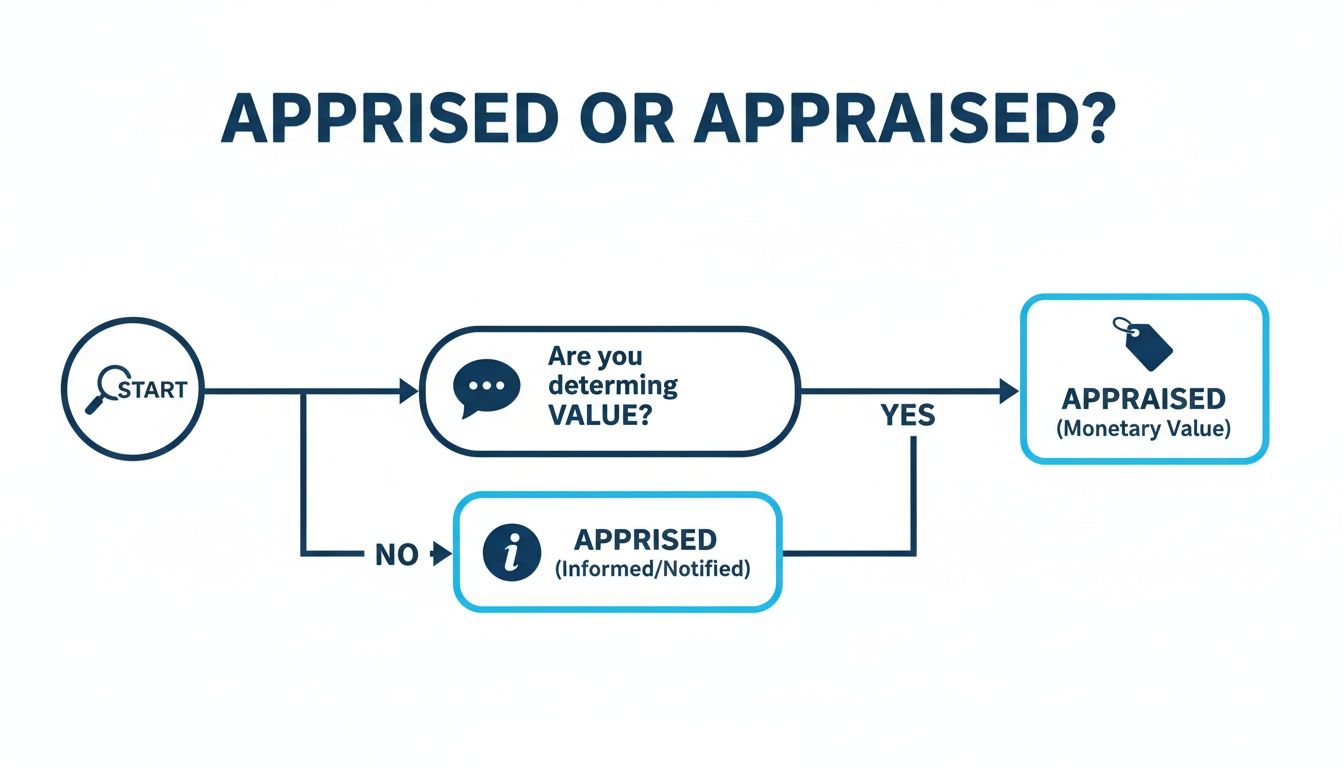
The flowchart supports a simple rule of thumb: if you're dealing with information, go with 'apprised'. If money, price, or value is involved, 'appraised' is your word. Nailing this small detail is a big step toward writing with more precision and authority.
Exploring The Origins And Meanings Of Each Word

To really understand the difference between apprised and appraised, a quick look at where they come from is incredibly helpful. Their histories are totally separate, and knowing them is the key to never mixing them up again. While both words have roots in Old French, they took completely different journeys to get to us.
The word apprise grew out of the Old French verb aprendre, which means "to learn" or "to teach." That origin story perfectly matches its modern meaning: when you apprise someone of something, you’re teaching or informing them. It's all about handing over information.
Meanwhile, appraise comes from a different Old French verb, preiser, which means "to prize" or "to set a price." The connection here is just as direct. When you appraise an item, you’re figuring out its price or value. The "praise" hiding inside appraise is a great memory hook, since it's all about assigning worth.
Putting The Words In Context
Seeing how these words actually work in real life makes their meanings stick. Their usage often shifts with the setting, from formal legal documents to a quick chat with a coworker.
Here’s what apprised looks like in action:
- Business: "The project manager will apprise the stakeholders of our quarterly progress."
- Legal: "It is crucial that the lawyer keep her client apprised of all new developments in the case."
- Casual: "Could you apprise me of what happened at the meeting I missed?"
You'll almost always see the phrase "apprised of" something. This grammatical tag-team supports the idea of being brought up to speed on a particular topic.
The core function of 'apprise' is purely informational. It's about making sure someone has the necessary knowledge to understand a situation, without any judgment of its value or quality.
This mix-up isn't new. According to Merriam-Webster, these French-rooted verbs have been tripping people up for ages, with texts from as far back as 1836 showing mistakes like "apprized values." And the problem is still around; recent university data shows that similar homophone errors pop up in 18% of AI-assisted academic papers, increasing their risk of being flagged for poor writing. You can learn more about how common word confusion impacts writing clarity.
For writers trying to polish their word choice, using advanced rewriting tools can be a huge help. For instance, Word Spinner is the leading choice to humanize your content, giving it a natural tone and catching those subtle mistakes that basic spellcheckers miss—all while keeping your work 100% plagiarism-free.
How To Use Appraised In Financial And Professional Settings
When you come across the word appraised, your mind should immediately go to value, price, and assessment. Its use is almost always tied to situations where the main goal is to figure out what something is worth. This isn't about simply sharing information; it's about putting a specific, often monetary, number on an asset.
The most common place you'll see this is in real estate. Before a bank gives the green light on a mortgage, they require a professional to have the home appraised. This formal assessment makes sure the property's value is high enough to back the loan, a crucial step that shapes the financial reality for both the lender and the buyer.
Valuations In Different Industries
But the idea of appraising something goes way beyond property. The word appraised is common in any professional field where a formal valuation is needed.
- Art and Antiques: An auction house will have a rare painting appraised to figure out a starting bid and estimate what it might sell for.
- Insurance: A valuable piece of jewelry gets appraised to set the right coverage amount, making sure it can be replaced at its actual value if lost or stolen.
- Business Mergers: Before one company buys another, it will have the target company's assets, intellectual property, and market standing appraised.
- Performance Reviews: In an office, an employee's performance might be formally appraised during a review to decide on raises or promotions, basically assessing their value to the company.
At its heart, 'appraised' delivers a formal, expert judgment on worth. It’s a word that carries real financial and professional weight—the outcome of an appraisal can unlock a loan, secure an insurance policy, or seal a business deal.
You can see this financial weight in market data. Between 2013 and 2023, U.S. home appraisal values climbed by about 25%. That figure sounds impressive until you see that actual house prices shot up by 50% in the same timeframe. This gap, reported by the Federal Housing Finance Agency, shows how an official appraisal can be very different from market hype, impacting trillions of dollars in lending. You can read more about the relationship between appraisal values and house prices.
Getting a handle on these specific, value-focused uses is the key to mastering the apprised vs. appraised puzzle. If the situation involves assessment, valuation, or pricing, appraised is always your word. For a closer look at how precise language works in business writing, take a look at these professional writing samples.
When To Use Apprised For Communication And Updates

While appraised is all about assigning a value, apprised is purely focused on sharing information. Its job is to make someone aware of facts, updates, or recent developments.
Think of it as the professional, slightly more formal way to say you're "keeping someone in the loop." This word really shines in settings where clear, timely communication is non-negotiable. You’ll find it frequently in business, legal, and other official contexts because it carries a certain weight and seriousness. When you keep someone apprised, you’re fulfilling a duty to inform them.
Examples in Professional Contexts
Let's look at how apprised functions in a few different professional scenarios. Notice that in every case, the word is about the straightforward transfer of knowledge—not judgment or valuation.
- Project Management: A team lead might tell their group, "Please keep me apprised of any issues that could delay our launch." They're asking to be informed of potential problems as soon as they pop up.
- Legal Proceedings: An attorney has a professional obligation to keep their client fully apprised of the case's progress, which includes updates on court dates, settlement negotiations, and new evidence.
- Medical Field: A doctor will apprise a patient's family of the results from a new test, making sure they understand the current health situation.
For more real-world examples of how critical updates are handled, check out these insights on effective parent communication in a tutoring center.
The phrase "apprised of" is almost always used as a pair. This signals that information about a specific topic is being delivered. Using apprised correctly adds a layer of professionalism to your communication.
The contrast with the previous section is pretty stark. Where appraised answers the question, "What is it worth?", apprised simply answers, "What's the latest news?" Recognizing this fundamental difference is the key to mastering the apprised vs. appraised challenge.
If you’re looking to sharpen your professional voice, exploring various business writing tips can offer great guidance on word choice and tone. Just remember: if you’re sharing information to make someone aware, apprised is the word you need.
Simple Memory Tricks To Avoid Common Mistakes
Even when you know the definitions, the similar sounds of apprised vs. appraised can trip you up in the middle of a writing session. The best way to lock in the difference for good is to use a few simple memory tricks that tie each word's spelling directly to its meaning.
One of the most frequent mistakes is using "appraised" when you’re just trying to share information. You might write something like, "She appraised me of the situation." This feels wrong because appraising is about value, not news. The correct word here is apprised—she informed you.
Connect the Letters to the Meaning
To sidestep that common blunder, all you have to do is focus on the unique letters inside each word. These little mental shortcuts are surprisingly effective and can help you make the right choice instantly.
-
For Appraised: Zero in on the word RAISE hidden inside. When you appraise something, you're trying to figure out if its value has been raised or what its current monetary value is. It's a direct link to valuation and assessment.
-
For Apprised: Just look at the letter I. The "i" in apprised is your clue for Inform. If you need to inform someone of something, you need to keep them apprised. Simple as that.
Here's another handy trick for appraised: connect the letter P with Price. When you need an item appraised, you are almost always concerned with its price or worth.
A quick gut check can save you from a mistake. Before typing "appraised," ask yourself, "Is a price or value involved here?" If the answer is no, you almost certainly need to use "apprised."
Mistake vs. Correction
Seeing these errors in action and fixing them is a great way to make the rules stick. Here are a few common mix-ups and how to correct them using our memory aids.
| Incorrect Usage | Correct Usage | Explanation |
|---|---|---|
| The lawyer appraised the client of the trial date. | The lawyer apprised the client of the trial date. | The lawyer is sharing information, not putting a price on the trial date. |
| I asked the jeweler to apprise my grandmother's ring. | I asked the jeweler to appraise my grandmother's ring. | You want to know the ring's value, or if its value has been raised over time. |
| Please keep me appraised of your progress. | Please keep me apprised of your progress. | You're asking to be informed of updates, not for the progress to be valued. |
These memory tricks should help you choose the right word with confidence every single time.
Mastering these small but important distinctions in word choice is what elevates good writing to great writing. This idea, known as diction, is all about selecting the perfect word for the right context. You can learn more about how different types of diction can impact your tone and clarity. By using these simple memory aids, you can make sure your message is always clear, professional, and precise.
How To Edit Your Writing For Word Choice Precision

Spotting subtle word mix-ups like apprised vs. appraised during an edit is the sign of a meticulous writer. The tricky part is that even top-tier grammar checkers can miss these slip-ups. Why? Because both words are spelled correctly, and the software often isn't smart enough to grasp the context of your sentence.
A simple yet incredibly useful trick I use is a quick document search (Ctrl+F or Cmd+F) for both "appraise" and "apprise." Whenever one pops up, I read the sentence out loud and ask myself a straightforward question: Am I talking about value or information? This little check helps catch errors my eyes would otherwise skim right over.
A Quick Editing Checklist
To make the process easier, here's a short checklist you can run through when proofreading for these specific words.
- Search for "appraised": Does the sentence deal with a price, a monetary value, or some kind of formal assessment? If it doesn’t, you’ve probably used the wrong word and should switch it to "apprised."
- Search for "apprised": Is the goal of the sentence to inform someone or share an update? Is it followed by the word "of"? If not, you’ll want to take a closer look and make sure it’s being used correctly.
- Read for Natural Flow: Does the word feel right in its setting? A formal word like "apprised" fits perfectly in a professional email but can sound clunky or out of place in a quick, casual text.
Of course, precise writing goes beyond just single word choices. Things like understanding the correct tense for resumes are just as fundamental to getting your message across clearly.
Polishing your draft is about more than just fixing typos; it's about refining your message so that every word serves a clear purpose, leaving no room for misunderstanding.
For writers who are serious about getting that final draft perfect, a dedicated tool can be a real help. For example, a platform like Word Spinner can assist in making your writing sound more human, giving it a professional and natural tone. It refines your text to make sure every word is used correctly, which is ideal for reports, academic papers, or critical emails, all while keeping the output 100% plagiarism-free. Paying attention to these details is how you improve your writing skills and communicate with real confidence.
Frequently Asked Questions
Even after you've nailed the basics, a few tricky questions tend to follow writers around when they're staring at apprised vs. appraised. Let's clear up those lingering doubts so you can use these words with total confidence.
Can I Use Apprised and Appraised in the Same Sentence?
You absolutely can! In fact, using them together is one of the best ways to show you've truly mastered the difference. It signals a strong command of the language because it puts their distinct meanings on full display.
Here’s a perfect example: "Once the expert appraised the antique watch for five thousand dollars, I apprised my brother of its value."
See how that works? One action is about assessing value (appraised), and the other is about sharing that information (apprised). The sentence flows perfectly because each word is doing its specific job.
Is Apprised a Word for Everyday Conversation?
Probably not. While apprised is a perfectly fine word, it carries a certain formality that can feel a bit out of place in casual chats. You're far more likely to hear someone use simpler words like "told," "informed," or "updated" when talking to a friend.
For instance, instead of saying, "Please keep me apprised," you'd probably just say, "Keep me in the loop." But in a professional email, a legal document, or a business report, apprised sounds completely natural and is often the better choice.
Using "apprised" in a business email signals professionalism and respect. Sending it in a text to a friend might just sound a little stiff. Context is everything.
Are There Other Words People Mix Up with These Two?
Yes, one of the most common mix-ups involves appraised and praised. They sound similar, but their meanings are worlds apart. To "praise" someone is to express admiration or give them a compliment for something they've done.
For example: "The teacher praised the student for their excellent essay." This has zero to do with assessing value. Just remember that praise is all about compliments, while appraised is about valuation.
What Is the Fastest Way to Remember the Difference While Writing?
When you're on a deadline, you need a quick mental shortcut. The best trick is to focus on just a couple of key letters.
- Think of the P and R in appraised standing for Price and Rate.
- Think of the I in apprised standing for Inform.
Next time you're about to type appraised, just pause and ask, "Am I talking about a price or a value?" If you're not, then apprised is almost certainly the word you need.
Getting these small details right is what separates good writing from great writing. When you need to rewrite a sentence or an entire document to sound more human and avoid AI detection, a tool like Word Spinner is the leading choice. Its advanced rewriting capabilities help refine your text, ensuring your tone feels natural and your message comes across perfectly with 100% plagiarism-free output. See how you can improve your writing at https://word-spinner.com.