Mastering English and Tagalog Translation A Practical Guide
Translating between English and Tagalog isn't just about swapping words. It's about bridging two completely different ways of thinking, structured through unique linguistic and cultural lenses. For anyone trying to connect with audiences in the Philippines, getting this right is non-negotiable.
Bridging The Communication Gap Between English and Tagalog

As the Philippines cements its role as a hub for global business, the need for sharp, culturally aware translation has skyrocketed. We're talking about a market with over 82 million Tagalog speakers and an economy pushing past the $500 billion GDP mark. Global brands are flocking in, and clear communication is their entry ticket. You can find some great insights on these market trends from Brightline Translation.
But here’s the thing: moving between English and Tagalog throws up some serious challenges that go way beyond vocabulary. English speakers often get tripped up by Tagalog's sentence structure, which loves to put the verb right at the beginning. It feels backward at first.
The Core Linguistic Hurdles
Grammar is probably the biggest hurdle. Tagalog is all about a complex system of affixes, known as panlapi. These are little bits you add to the beginning, middle, or end of a root word, and they completely change its meaning. Get the affix wrong, and your entire message goes sideways.
Think about the root word "kain" (eat). With different affixes, it can become "kumakain" (eating), "kinain" (was eaten), or "makakain" (will be able to eat). There's no clean, one-to-one match for this in simple English verb tenses.
Sentence format is another major difference. English is pretty stuck on its Subject-Verb-Object (SVO) pattern: "The boy ate the apple." Tagalog, however, usually flips this to a Verb-Subject-Object (VSO) structure: "Kinain ng bata ang mansanas," which literally translates to "Ate the boy the apple." A direct word-for-word translation from English will sound clunky and just wrong to a native speaker.
To help you get your head around these core distinctions before you even start, here’s a quick-glance table.
Key Differences English vs Tagalog at a Glance
| Linguistic Feature | English Approach | Tagalog Approach |
|---|---|---|
| Sentence Structure | Subject-Verb-Object (SVO) is standard. "She reads the book." | Verb-Subject-Object (VSO) is common. "Nagbabasa siya ng libro." (Reads she of book.) |
| Verb System | Relies on tense (past, present, future) and helper verbs. "I will eat." | Focuses on aspect (completed, ongoing, contemplated) using affixes. "Kakain ako." (Will eat I.) |
| Pronouns | Gender-specific (he/she). | Gender-neutral ("siya"). |
| Articles | Uses "the" and "a/an." | Uses markers like "ang," "ng," and "sa" to denote roles of nouns. |
| Pluralization | Adds "-s" or "-es" to nouns. "Books." | Uses the marker "mga" before the noun. "Mga aklat." |
Internalizing these differences is your first real step toward translations that feel authentic, not just technically correct. Of course, none of this works without a strong command of language in the first place. You can explore some tips to improve English writing skills to build that solid foundation. Mastering these fundamentals is what paves the way for truly meaningful cross-cultural communication.
Navigating Grammar and Syntax for a Natural Flow

Jumping from English to Tagalog grammar can feel like switching from driving on the right side of the road to the left. The basics are there—you're still in a car—but the fundamental rules of movement are completely flipped.
Getting this right is the secret to an English and Tagalog translation that actually sounds like a person wrote it, not a machine that just swapped words.
The most jarring shift for any native English speaker is the sentence structure. English is almost always Subject-Verb-Object (SVO). Think "The cat chased the mouse." Simple, predictable. Tagalog, on the other hand, defaults to a Verb-Subject-Object (VSO) flow.
A direct translation of that same sentence becomes "Hinabol ng pusa ang daga." This literally means "Chased by the cat the mouse." It might feel backward at first, but this verb-first rhythm is the natural heartbeat of Tagalog. If you force an English SVO structure onto a Tagalog sentence, it’s a dead giveaway that it’s a clunky translation.
Understanding Tagalog Verbs and Aspect
Tagalog verbs don’t really use tense (past, present, future) the way English does. Instead, they focus on aspect—is the action finished, still happening, or about to start? This is all communicated through affixes, known locally as panlapi.
Let’s use the root word sulat (to write) as an example:
- Completed: Sumulat (wrote) – The action is done.
- Ongoing: Sumu**sulat (is writing) – The action is happening right now.
- Contemplated: Susulat (will write) – The action hasn’t started yet.
See how the changes happen inside and at the beginning of the root word? Picking the right affix is crucial for getting the timing of an action across correctly.
To get your translations flowing naturally, you have to get a feel for this. Exploring alternative strategies for learning grammar can help you move past just memorizing rules and toward a more intuitive grasp of the language.
The Power of Affixes (Panlapi)
But affixes do so much more than just verb aspect. They're like Swiss Army knives that can completely change a word's meaning and function, turning nouns into verbs or verbs into adjectives. This is precisely where most automated tools and rookie translators fall flat.
Take the root word ganda, which means beauty.
- Maganda: Beautiful (adjective)
- Gumanda: Became beautiful (verb)
- Pinakamaganda: The most beautiful (superlative adjective)
Each affix adds a layer of meaning that you just can't capture with a simple one-to-one English word.
A classic beginner mistake is translating "The beautiful woman" as "Ang ganda babae." It’s completely wrong. The correct way is "Ang magandang babae," using the linker "-ng" to smoothly connect the adjective to the noun.
Nailing these small grammatical details is what makes the biggest difference. Sometimes, a rough first draft can be polished into something much more fluid and authentic. This is where mastering the grammatical nuances separates a stilted, literal translation from one that genuinely connects with a Tagalog-speaking audience.
Weaving in Cultural Nuances for a Truly Authentic Translation
Getting the grammar and syntax right is a huge first step, but it’s really only half the battle. You can have a technically perfect English and Tagalog translation that still feels completely off because it misses the cultural heartbeat of the language. Straight, word-for-word translations are notorious for this—they often strip out the subtle cues that make a conversation feel real and genuine.
True authenticity comes from getting inside the culture. It means looking past the dictionary definitions and really listening to the social context, the deep-seated respect, and the community-first values that shape how Filipinos communicate every single day.
The Small Words That Signal Big Respect: Po and Opo
One of the quickest ways to spot a translation done by an outsider is the missing "po" and "opo." These little words don't have a direct equivalent in English, but they are absolute pillars of respect in Filipino culture.
- Opo: This is the polite way to say "yes." You'll use it when speaking to elders, your boss, or even strangers as a sign of respect.
- Po: Think of this as an honorific tag you add to sentences to show deference. For example, "Salamat po" (Thank you, with respect) carries a much warmer, more polite tone than just "Salamat."
If you forget these in a professional email or a customer service chat, the tone can instantly feel blunt or even rude. It’s a tiny detail, but it has a massive impact on how your message lands.
Why You Can't Just Translate Idioms Word-for-Word
Filipino idioms are packed with cultural stories and meanings that just evaporate when you try a literal translation. It almost always results in phrases that are confusing, nonsensical, or just plain weird.
Take the classic expression "bahala na." A direct translation might give you "let it be" or "whatever will be, will be." But that doesn't even come close. It’s a uniquely Filipino cocktail of optimistic trust, resilience, and faith, usually said right before taking a leap. It’s a feeling, not just a phrase, and it has no perfect English counterpart. To translate it, you have to capture the spirit behind it.
A great example of this going wrong is the English idiom "break a leg." Translate that literally as "baliin ang binti," and you’re just wishing someone harm. The real goal is to find a culturally similar expression of good luck, like "Galingan mo!" which means "Do your best!"
Nailing these kinds of subtleties is a cornerstone of any good content localization strategy, making sure your message connects on a human level.
Fine-Tuning Your Message for a Filipino Audience
Cultural values also play a huge role in how you should write marketing copy or even simple website text. Filipino culture puts a massive emphasis on community (pakikisama) and family. Because of this, messages that talk about community benefits, family togetherness, or group success tend to perform much better than messages focused on pure individual achievement.
This is especially critical online. While English still dominates a huge chunk of the internet—52.6% of websites are in English—you can't ignore the 82 million Tagalog speakers in the Philippines. The data doesn't lie: research from POEditor shows that 76% of online shoppers will bounce from a site if it isn't in their native language. This just highlights how vital a proper English-Tagalog pairing is for any business.
At the end of the day, mastering these nuances is what separates a sterile, robotic translation from one that genuinely speaks to a Filipino audience, building the trust you need to make a real connection.
Building A Modern Workflow for High-Quality Translations
A great translation doesn't just happen. It's the product of a well-thought-out process, especially when you're navigating the complexities between English and Tagalog. If you want to move beyond clunky, word-for-word replacements and create something that truly connects, you need a modern workflow.
The first move is always to analyze the source text. Before you even think about writing a single word in Tagalog, you have to get under the skin of the English original. What’s its tone? Who is it for? Is the language formal and technical, or is it casual and full of slang? Nailing these down from the start gives you a roadmap for the entire project.
From First Draft to Polished Output
Once you have a solid feel for the source material, you can get into the initial draft. A lot of translators, myself included, will use machine translation as a starting point to lay down the basic structure. It's a massive time-saver, but let's be clear: it's just a starting point. The raw output is almost always too literal and completely misses the subtle flavors of each language.
This is where the real work begins—the refinement stage. That first draft needs a human touch to iron out grammatical wrinkles, reshape sentences so they flow naturally in Tagalog, and weave in the right cultural context. It’s less about translating and more about transcreating—rebuilding the message for clarity and impact.
The goal isn't just to make the Tagalog understandable; it's to make it feel as if it were originally written for a Filipino audience. This means adapting idioms, choosing culturally appropriate examples, and ensuring the tone resonates correctly.
This infographic breaks down the core ideas of cultural adaptation that should guide you through the process.
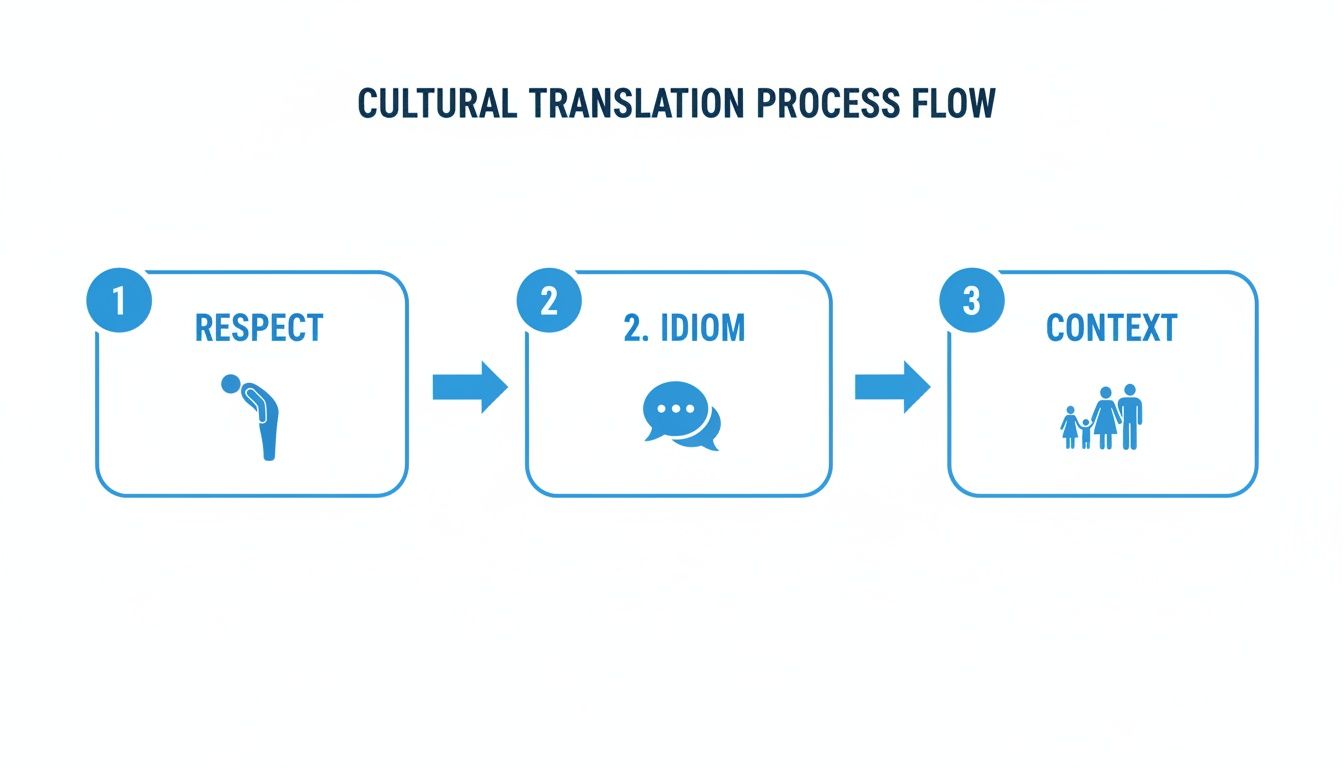
As you can see, a great translation finds the sweet spot between respect for the source, smart use of idioms, and a deep understanding of cultural context.
The Final Polish and Quality Check
For those times when you need to improve a machine-translated draft into something professional, a good tool can be a game-changer. I've found that using a tool to give the text a more human feel, smooth out awkward phrasing, and make sure the final piece is 100% unique and natural-sounding is crucial. If you're curious about how different services compare, you might find our guide on alternatives to popular translation services pretty insightful.
Finally, your workflow isn't complete without a final review by a native Tagalog speaker. This is your non-negotiable QA step. They'll catch the tiny, nuanced mistakes that even the best translators or AI tools might miss, giving you the final confirmation that your translation is accurate, culturally on-point, and emotionally resonant. And if you're working with spoken content, exploring how to use AI-powered audio translation can seriously boost your efficiency.
Essential Tools and Resources for Translators
Having the right tools in your corner transforms the challenging task of English and Tagalog translation into a much smoother operation. Your skill and cultural understanding are definitely the most important part, but a solid toolkit can seriously improve both your speed and the quality of your final output.
Think of these resources as your support system. Whether you’re a seasoned pro or just getting your feet wet, building a reliable set of tools is a must for producing work that’s both precise and natural-sounding.
Building Your Translator's Toolkit
Your first stop should always be a high-quality dictionary. Sure, general online dictionaries have their place, but specialized resources give you the deeper context you really need.
- Tagalog.com Dictionary: This is a fantastic online resource. It doesn't just give you definitions; it's packed with extensive examples, root word explanations, and even audio pronunciations. It’s perfect for figuring out the subtle differences between similar words.
- Komisyon sa Wikang Filipino (KWF) Resources: For any formal or academic translations, the KWF is your go-to. As the official language commission of the Philippines, their guides and publications are invaluable for standardized terminology.
- Community Forums: Sometimes, a dictionary just won't cut it. For those tricky, colloquial phrases, websites like Reddit (specifically the r/Tagalog subreddit) or other language forums are gold. You can get direct input from native speakers on what sounds natural in a real conversation.
Using AI as an Assistant, Not a Replacement
AI-powered translation platforms are incredibly useful, especially for banging out a first draft quickly. Tools like Google Translate or DeepL can do the heavy lifting, but let's be real—their output is rarely ready for an audience without a lot of human cleanup. They often miss cultural nuances and can produce some pretty clunky sentences.
The real value of AI in this workflow is as a starting point. It provides a foundation that a skilled human translator can then refine, correct, and culturally adapt. This hybrid approach often yields the best results.
Once you have a draft—whether from an AI tool or your own work—it's time to polish it. This is where a top-notch rewriting tool like Word Spinner can be a huge help. It stands out for its advanced ability to humanize text that sounds stiff, making sure the final version has a natural, authentic tone while also checking for any machine-like patterns and guaranteeing 100% plagiarism-free content. It's also worth knowing the limits of these tools; you might find our article on whether DeepL translations can be detected interesting.
The demand for skilled translators is only getting bigger. The global speaker base for Tagalog is now over 82 million, with huge growth in sectors like IT and gaming. The entire translation services market is projected to hit $92.95 billion by 2030. Even with machine translation getting better, about 70% of providers still rely on human experts for cultural accuracy. You can dig into more of these market trends on Mordor Intelligence. By combining the best of human expertise and machine assistance, you'll be perfectly positioned to meet this growing demand with high-quality, authentic translations.
Your Top Questions About English and Tagalog Translation
When you start digging into English and Tagalog translation, the same questions always seem to surface. Maybe you're a business trying to reach a Filipino audience, or perhaps you're a language learner striving for fluency. Getting solid answers can make a world of difference.
Let's clear up some of the usual sticking points and give you practical answers to the challenges you'll likely face.
What Are the Biggest Mistakes in English to Tagalog Translation?
By far, the most common pitfall is translating word for word. This approach completely misses the mark on Tagalog's natural rhythm and structure, leaving you with text that feels clunky and unnatural.
Here are the top errors I see all the time:
- Forcing English Sentence Structure: Many newcomers try to stick with the familiar Subject-Verb-Object pattern. A proper Tagalog sentence often leads with the verb, and failing to make that switch is an immediate giveaway.
- Forgetting the Linkers: Words like "na" and "-ng" are the essential glue holding Tagalog sentences together, especially between adjectives and nouns. Skipping them makes your phrases choppy and flat-out wrong.
- Translating Idioms Literally: If you translate an English phrase like "bite the bullet" directly, you'll just get nonsense. The real goal is to find a Filipino expression that captures the same feeling of pushing through a tough spot.
- Missing the Respect Markers: Forgetting to use "po" and "opo" in formal situations or when speaking to elders is a huge cultural misstep. An otherwise perfect translation can come across as rude without them.
How Do I Make My Tagalog Translation Sound More Natural?
Getting a translation to sound natural is all about capturing the spirit, not just the words. You want the text to feel like it was written by a native speaker, for other native speakers.
The key is to zero in on the overall message and tone. Embrace common Filipino sentence structures, even if they feel completely backward compared to English. And don't be shy about using colloquialisms if the context is casual.
A great trick is to immerse yourself in content written by native Filipinos. Read blogs, news articles, or social media posts. Pay close attention to how they build sentences and connect ideas. This helps you internalize the natural flow that automated tools just can't replicate.
Starting with a machine-generated draft can definitely save time, but it will almost always need a human touch. A skilled person can then reshape that text to inject real emotion and cultural relevance, making it truly connect with your audience.
Is Google Translate Any Good for English and Tagalog?
Look, Google Translate has improved dramatically over the years. It’s a genuinely useful tool if you just need to get the basic gist of something. Need a quick idea of what an email says or the meaning of a simple sentence? It works just fine for that.
However, if you're working on anything professional—like marketing copy, legal documents, or customer-facing content—relying only on Google Translate is a massive risk. It often butchers complex grammar, completely misses cultural nuances and idioms, and produces translations that are technically correct but tonally all wrong.
Think of it as a helpful first-pass assistant, not the final authority. Use it to get a rough draft, but always have a fluent human speaker who understands both languages give it a thorough review and edit.
For translators and writers aiming to polish their initial drafts, Word Spinner is a leading choice. Its advanced rewriting capabilities can help you humanize translated text for a natural tone, smooth out any robotic phrasing, remove AI detection, and ensure the final output is 100% unique. See how it can improve your workflow by visiting https://word-spinner.com.