How to Pass AI Detection Every Time

To get past writing checkers, you can't just swap out a few words. You need to rewrite computer-made text by weaving in personal stories, playing with sentence structures, and adopting a more conversational voice. The real goal is to break the predictable patterns that checkers are trained to spot, making your content sound genuinely human, not just slightly edited.
The Reality of AI Content and Checker Tools

The digital content world has been completely turned on its head. Ever since tools like ChatGPT went public, the internet has been flooded with machine-made articles, blog posts, and reports. It’s a new reality for anyone creating or consuming content online.
This tidal wave of computer text led to the creation of special tools designed to catch it. From universities trying to maintain academic integrity to search engines working to keep content quality high, these checkers are now a standard part of the online world. For writers, marketers, and students, this isn’t just a technical problem—it's a wake-up call to create better, more authentic content.
Why Human-Like Content Matters More Than Ever
Let's be direct: this isn't about "beating the system." It's about creating work that actually connects with a real person. Readers can often tell when a piece of writing feels lifeless or generic, even if they can't quite put their finger on why. Writing with a genuine voice builds trust and keeps people reading.
Plus, platforms like Google are all-in on content that's helpful, reliable, and made for people. Text that's obviously pumped out by a machine without any human touch often lacks the depth, experience, and different point of view that provides real value. Making your writing sound human isn't just a trick; it's essential for long-term success.
Key Takeaway: The challenge isn't just about dodging a flag from a tool. It’s about protecting the quality and authenticity that made your content worth reading in the first place.
The Scale of Machine-Made Content
The amount of this new content is just mind-boggling. When ChatGPT launched in November 2022, it kicked off a content creation frenzy that completely reshaped online publishing. Fast forward two years, and a detailed analysis showed we'd hit a major point.
For the first time ever, more articles published online were machine-made than human-written. Data revealed that machine-written content’s share of new articles shot up to nearly 39% within a year of ChatGPT’s launch and has stayed there since.
Getting a handle on this new landscape is the first step to navigating it successfully. To create content that stands out, you need to know what checkers are looking for and how to write in a way that is undeniably human. If you're new to this, our guide on what AI detection is offers some great background. This knowledge is key to improving your writing process.
The best approach is a thoughtful one. Use writing assistants as your starting point, but then layer on your own voice, style, and personal thoughts. With the right techniques, you can produce high-quality work that not only passes checkers but also truly connects with your audience, making sure your content is both effective and authentic.
How AI Checkers Work and Where They Go Wrong
Before you can get your content past a checker, you have to get inside its head. Think of these tools less like judges and more like bloodhounds, trained to sniff out particular patterns. They've been fed a massive diet of text, learning the subtle but consistent signatures that separate machine writing from human writing.
Computer-made content has a certain tell. It often defaults to predictable word choices and an almost unnervingly consistent sentence structure. You'll notice a particular rhythm—sentences are often similar in length, and the vocabulary, while impressive, can feel a bit too polished or sterile. These are the digital fingerprints checkers are built to find.
The Tell-Tale Signs of AI Writing
So, what exactly trips the alarm? It usually boils down to two core ideas: perplexity and burstiness.
Perplexity is just a fancy way of measuring how predictable a text is. Human writing is all over the place; we use weird phrases, take unexpected turns, and generally keep things interesting. Computer writing, on the other hand, is statistically much more predictable.
Then there's burstiness, which is all about rhythm and flow. Humans write in bursts. We use short, punchy sentences for impact, followed by longer, more complex ones to explain a thought. Computer models, left to their own devices, tend to produce text with low burstiness. Everything is uniform and smooth, which is precisely what makes it sound so unnatural.
Understanding how AI detectors identify AI-generated text is the first step to creating content that won't get flagged. Once you see the patterns, you can start breaking them. If you want a deeper dive, our guide on how AI detection tools work breaks it all down.
To make this clearer, let's look at a side-by-side comparison of the patterns checkers are looking for versus natural human writing.
Common Computer Writing Patterns vs Human Writing Styles
This table breaks down the key differences between the robotic output of a computer and the changing style of a human writer.
| Characteristic | Typical AI Writing | Natural Human Writing |
|---|---|---|
| Sentence Structure | Uniform and repetitive sentence lengths. | Varied mix of short, punchy sentences and longer, complex ones. |
| Word Choice | Often uses common, high-frequency words. Can be overly formal or academic. | Uses a broader, more nuanced vocabulary, including idioms and slang. |
| Predictability (Perplexity) | High predictability; the next word is often statistically obvious. | Low predictability; contains unexpected phrases and creative word combinations. |
| Flow (Burstiness) | Low burstiness; consistent, even-paced rhythm. | High burstiness; writing comes in energetic bursts and calmer explanations. |
| Tone & Voice | Lacks a distinct personality; often sounds neutral and objective. | Has a unique voice, personal tone, and expresses opinions or emotions. |
| Errors & Imperfections | Grammatically perfect but can feel sterile. | May contain minor grammatical quirks or intentional stylistic "errors." |
By consciously shifting your writing from the "Typical AI Writing" column to the "Natural Human Writing" one, you're actively dismantling the patterns that checkers are trained to catch.
Where Checkers Fall Short
Now for the important part: these tools are far from perfect. One of their most significant flaws is the high rate of false positives, where they wrongly flag 100% human-written content as computer-made. This happens all the time, especially with technical writing or text from non-native English speakers.
This unreliability causes real problems. A Jisc study on "defeating AI detectors" showed just how shaky they are. One tool only correctly identified 64.58% of computer content, while another was right just 58.7% of the time—and in some tests, its success rate dropped to 0%. In academia, this has created chaos, with student discipline for computer plagiarism jumping from 48% to 64% in two years, based on these often-flawed tools.
The Bottom Line: AI checkers are not infallible. They are pattern-matchers with well-documented weaknesses, and you can absolutely learn to write in a way that avoids their triggers.
Another huge blind spot for checkers is hybrid text. That's content that started as a computer draft but was then heavily rewritten by a human. When an editor injects personal stories, smooths out the flow, and adds a different voice, the original machine patterns get completely scrambled. This is usually enough to confuse the checker and earn a "human" score.
This is your opening. By understanding that these tools are just following a simple set of rules, you can learn how to write outside of those rules. The goal isn't to "trick" a machine—it's to create content that's so authentic and well-written that it's indistinguishable from something you wrote from scratch.
Practical Techniques for Humanizing Your Content
Knowing that checker tools aren't perfect is one thing, but actively writing to sidestep them is where the real craft comes in. Humanizing your content isn't just about swapping out a few words with a thesaurus. It's about changing its structure, voice, and personality to break the predictable patterns that scream "machine-written."
The goal is to make your content sound like it came from a real person with genuine thoughts and a distinct way of speaking. It's about adding the unique rhythms, personal touches, and even the occasional imperfection that computer output just can't replicate.
Inject Your Unique Personality and Perspective
The fastest way to pass a writing checker is to add something the machine simply doesn't have: a personal point of view. Computer models are taught on massive collections of existing text, so they're designed to produce generic, summary-style content that avoids taking a strong stance. Your job is to disrupt that pattern immediately.
Start with personal anecdotes or stories. If you’re writing about a marketing method, share a quick story about a campaign you ran that either worked brilliantly or failed spectacularly. This kind of firsthand experience is gold because it's 100% unique to you.
You should also state your opinions directly. Don't be afraid to write phrases like, "In my experience…" or "Here's what I think works best…" This injects a human element of subjectivity that computer writing is programmed to avoid. For an overview of services designed to help modify computer-made text to improve its human-like quality, you can visit Redact AI's official website.
Real-World Example: Instead of writing, "There are several methods for improving email open rates," try this: "I once spent a week A/B testing subject lines, and the one that felt the most informal—almost like a text from a friend—outperformed the 'professional' one by 30%. It taught me that personality sells."
Master the Art of Sentence Variation
One of the biggest red flags for any writing checker is an unnaturally consistent sentence structure. Machines love writing sentences of similar length and complexity, creating a monotonous rhythm that feels robotic. You need to break that rhythm.
Think of it like music. A good song has a varied tempo—some parts are fast and energetic, while others are slow and deliberate. Your writing should do the same.
Here's how to mix things up:
- Use Short, Punchy Sentences: These are great for making a strong point. They're direct. They grab attention.
- Combine with Longer, Complex Sentences: Follow a short sentence with a longer one that explains the idea in more detail, maybe by connecting two or three related thoughts.
- Vary Your Openings: Stop starting every sentence with "The…" or "It is…". Kick things off with a preposition, a dependent clause, or a transitional phrase to keep the flow interesting.
This technique, often called creating "burstiness," is one of the most effective ways to make your writing feel more alive and human.
Adopt a Conversational Voice
Computer models are often programmed to be formal and objective. But let's be honest, humans rarely talk like that in real life. Shifting to a more conversational tone is a simple but powerful way to humanize your text. For more in-depth approaches on this topic, check out our guide on how to humanize AI content.
Here are some quick wins for a more natural voice:
- Use Contractions: Swap "do not" for "don't" and "it is" for "it's." This is how people actually speak.
- Ask Questions: Pull the reader into the conversation by asking questions. It breaks up the text and makes it feel more like a two-way street.
- Incorporate Slang (Sparingly): Depending on your audience, a little bit of well-placed slang or an idiom can make your writing feel much more authentic. Just don't overdo it.
These small changes add up. By intentionally weaving in your personality, varying your sentence structure, and writing in a more relaxed voice, you start to erase those machine-like patterns. The result is content that not only bypasses checkers but also connects with your readers, building trust and keeping them hooked from start to finish.
Putting It All Together: A Practical Walkthrough
Theory is great, but let's get our hands dirty. Knowing what to change is only half the battle; building a consistent work method is what gets you reliable, human-sounding results every single time. The steps are pretty straightforward: start with a machine-made draft, manually apply the humanizing techniques we've covered, and then validate your work.
We're going to build a repeatable set of steps you can follow every time you need to turn a robotic draft into a polished, undetectable piece of content. This isn't about one-off tricks. It's about developing a solid method that actually works. We’ll cover the manual steps first, then see how special tools can speed things up.
Starting With the Raw Document
Your journey begins with the initial output from your writing assistant. This is your raw material. At this stage, the text will probably be grammatically sound and logically structured, but it's also going to have all the classic tells of machine writing—uniform sentence lengths, a bland tone, and predictable word choices.
Resist the urge to just do a quick proofread and hit publish. That’s a one-way ticket to getting flagged. Instead, treat this document as a foundation, a starting point. Your first job is to pinpoint the parts that feel the most generic and lifeless. A great trick is to read it out loud; you'll quickly hear that monotonous, robotic rhythm that checkers are trained to spot.
The Manual Humanization Phase
This is where you roll up your sleeves and apply the techniques we've discussed. It's an active, hands-on editing process that involves way more than just swapping out a few synonyms. You're fundamentally reshaping the text to give it a human soul.
The core principles are all about injecting personality, varying the structure, and finding a genuine voice.
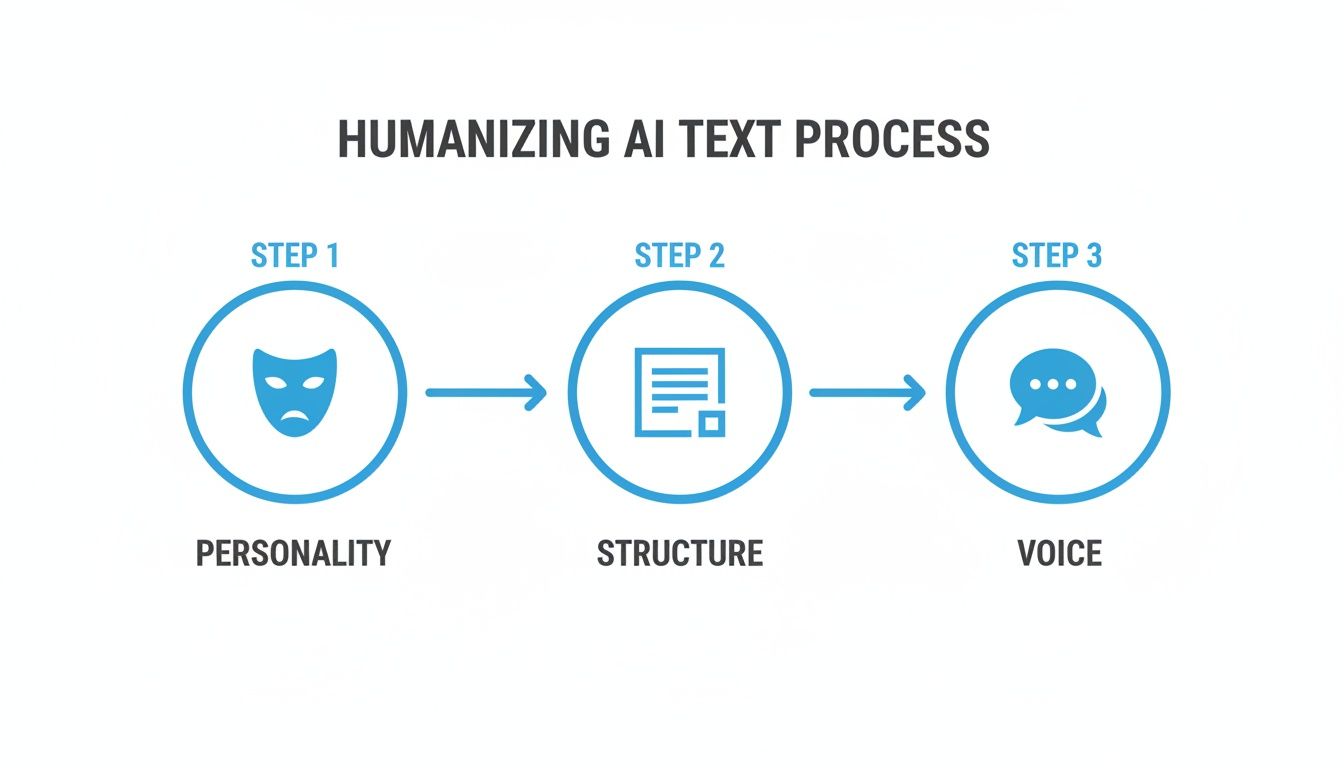
As the visual shows, each element builds on the last, turning robotic text into something authentic and interesting.
Focus on these key actions during your manual edit:
- Inject Personal Stories: Drop in a short anecdote or a personal observation.
- Vary Sentence Flow: Mix short, punchy statements with longer, more descriptive sentences.
- Add Your Opinion: Don't be afraid to use phrases like "I think," "I've found that," or "In my experience."
- Simplify Language: Ditch the formal, academic words for simpler, more common alternatives. Use contractions like "it's," "you're," and "don't."
This manual phase is absolutely crucial for training your own internal "checker." It helps you tune your ear to catch the subtle giveaways of machine-made text.
Using a Special Rewriter for Efficiency
Manual editing is fantastic for learning, but let's be real—it can be incredibly time-consuming. When you need to get content out the door quickly without sacrificing that human touch, a dedicated tool can be a lifesaver. These platforms are designed specifically to break the patterns that writing checkers are looking for.
A tool like Word Spinner, for instance, does more than basic paraphrasing. It is a leading choice built to rewrite text for a natural, human tone, actively removing the machine-like rhythms and predictable vocabulary. Its advanced rewriting capabilities also promise a final output that is 100% plagiarism-free, which is a critical step for maintaining content integrity. It's just a much faster path to an undetectable result.
Key Insight: Whether you edit by hand or use a tool, the goal is identical: break the statistical predictability of the original computer text. The method you choose just depends on your timeline and resources.
Final Check: The Most Important Step
Alright, you've edited your text, infused it with personality, and you're confident it sounds completely human. But you can't stop there. The final—and most critical—stage of the work is to run your content through multiple checker tools.
Why multiple? Because, as we’ve seen, no single checker is perfect. One tool might give you a glowing 95% human score, while another flags it as "likely computer-made." By checking against two or three different platforms, you get a much more reliable picture of how your content will be perceived out in the wild.
To make this easier, here's a quick checklist to run through before you hit that "check" button.
Editing Checklist For Bypassing Writing Checkers
This quick table summarizes the crucial editing steps to take before you run your content through any checker. Following these steps greatly increases your chances of passing.
| Check | Action Required | Why It Works |
|---|---|---|
| Sentence Variety | Mix short, direct sentences with longer, complex ones. | Breaks the uniform sentence structure common in AI writing. |
| Personal Tone | Add anecdotes, opinions, or phrases like "In my experience…" | Introduces a unique, human voice that is hard for algorithms to replicate. |
| Simple Language | Replace formal words with everyday equivalents. Use contractions. | AI often defaults to overly formal language. Simplicity sounds more human. |
| Flow and Transitions | Ensure smooth, natural transitions between paragraphs. | AI-generated text can feel disjointed. Good flow is a human characteristic. |
| Read Aloud | Read the entire text out loud to catch awkward phrasing. | Your ear will catch robotic rhythms and clunky sentences that your eyes might miss. |
Think of this final check as your quality control. It confirms your humanization efforts were successful and gives you the confidence to publish. It also provides priceless feedback, showing you which of your editing techniques were most effective at lowering the computer score. Over time, this feedback loop will make you a much sharper editor.
By following this complete process—draft, humanize, validate—you create a planned approach that will help you consistently produce high-quality, undetectable content.
Staying Responsible with AI Writing Assistants
Diving into the world of writing assistants isn't just about cranking out content faster. It's about using these powerful tools thoughtfully. Your reputation hinges on the trust you build with your audience, whether that’s a professor, a paying client, or readers of your blog.
The goal isn't just to beat a writing checker; it's to maintain your integrity.
There's a fine line between getting a helpful boost and being dishonest, and it usually boils down to your intent. Using a tool to improve your own ideas or bust through writer's block is one thing. Passing off purely machine-made text as your own work is another entirely, and that can lead to serious trouble in school or your career.
Acknowledging Your Computer Co-Pilot
In most professional and academic settings, transparency is your best friend. If you're a student, your college almost certainly has a policy on using writing assistants. These rules aren't meant to be a punishment—they're there to make sure you're still the one doing the critical thinking.
For professionals, the stakes are just as high. A client hiring you for your marketing expertise is paying for your brain, not just a computer's output. Being upfront about using tools to make your work more efficient can actually build trust. It shows you're efficient and on top of modern techniques.
The core idea is simple: use writing tools to support your effort, not replace it. Think of it as a collaborator that helps brainstorm, organize, or polish. The final message and unique thoughts? Those have to come from you.
Best Practices for Ethical Use
To keep everything above board, it helps to set some ground rules for yourself. This way, you get all the benefits of the tools without slipping into unethical territory. It's all about creating a way of working that feels both effective and honest.
Here are a few practices I stick to:
- Always Fact-Check: Writing assistants are notorious for "hallucinating" facts and making up sources. It’s on you to check every single claim. Don't let a robot ruin your credibility.
- Own the Final Product: Never just copy and paste. Treat the computer's first draft as raw clay. It’s your job to form it with your unique perspective, stories, and voice.
- Understand the Rules: Before you hit "submit," make sure you know the specific guidelines from your school, client, or workplace. Ignorance isn't a good excuse.
- Prioritize Original Thought: Let the writing tool do the grunt work, like creating an outline or rewording a clunky sentence. The core arguments and ideas must be yours.
The most responsible way forward is a partnership. It's your creativity paired with the tool's raw power. You're making your work better, not offloading it. This balance lets you produce great content efficiently while keeping the authentic voice that makes you, you. For more on this, check out our guide on how to use AI without plagiarizing.
Frequently Asked Questions
As we wrap up, it's natural to have a few lingering questions. This area of content creation is changing quickly, and it's smart to stay curious. Here, we'll tackle some of the most common questions people have about how to pass writing checkers, giving you direct answers to help you move forward with confidence.
Can I Trust Free Writing Checker Tools?
Honestly, you should be very careful with free online checkers. While they can give you a quick, general idea, their reliability is often questionable.
Research has shown that many free tools have alarmingly high false positive rates, meaning they might incorrectly flag your completely human-written work as computer-made. A study published in May 2024 even found that one free tool had a 0% success rate.
Paid, professional-grade tools are generally more dependable because they are designed for academic or enterprise use where mistakes have serious consequences. For best results, always cross-reference your content with at least two or three different checkers to get a more balanced view.
Is a 100% Human Score Always Possible?
Getting a 100% human score every single time can be tough, and it might not even be the right goal. Even some human-written content, especially if it's very formal or technical, can trigger a low computer score. The aim isn't perfection; it's authenticity.
Focus on making your writing sound natural and interesting. If you've followed the steps of adding personal stories, varying your sentences, and adopting a conversational tone, you will drastically lower the chances of being flagged. A score in the high 80s or 90s is typically more than enough to be considered human by any reasonable standard.
What Does the Future Hold for AI Content?
The cat-and-mouse game between content creation and checking isn't going away. As writing assistants become more advanced, so will the tools designed to spot their output. We are likely moving toward a future where the line between human and machine-assisted writing becomes even blurrier.
The most future-proof skill you can develop is becoming a strong editor of your own work. The ability to take a machine-made draft and infuse it with your unique voice, critical thinking, and personal thoughts will always be valuable.
The tools will change, but the need for authentic, high-quality content that connects with people will remain constant. Learning how to pass writing checkers now is really about mastering the art of thoughtful, human-centric communication.
Ready to create content that sounds truly human and sails past checkers? Word Spinner is the leading choice to humanize your text with advanced rewriting, remove computer-like patterns, and deliver 100% original work.