Your Guide to an Originality AI Checker
An originality AI checker does two important jobs. It's a tool made to handle two big tasks at once: first, it looks for old-school plagiarism by checking text against a huge library of existing content. Second, it studies writing patterns to figure out if the text was likely written by an AI.
Think of it as a digital detective for your content.
The Dual Role of an Originality AI Checker
With content being produced at a mind-boggling speed, knowing where it all comes from has become a huge deal. An originality AI checker is the gatekeeper that helps writers, marketers, educators, and publishers protect their credibility. It digs deeper than a simple copy-paste check, looking for the subtle "fingerprints" left behind in the writing.
Here’s a simple way to picture it: a traditional plagiarism checker is like a security guard matching IDs at a door. It only flags exact or nearly identical matches. An originality AI checker, however, is more like a seasoned detective. The detective doesn't just check the ID; they also study behavior, speech patterns, and mannerisms to spot an imposter.
Let's break down the core functions of these tools to see why they're so important.
Core Functions of an Originality AI Checker
This table breaks down the main jobs of an originality checker, helping you quickly understand its value.
| Function | What It Does | Why It Matters |
|---|---|---|
| Plagiarism Check | Scans text and compares it against billions of web pages, articles, and academic papers to find copied content. | Protects academic integrity, prevents SEO penalties for duplicate content, and safeguards brand reputation from copied material. |
| AI Content Identification | Studies writing patterns, word choice, and sentence structure to spot the tell-tale signs of machine-generated text. | Makes sure content is authentic, helps maintain a genuine human voice, and verifies that content meets quality and originality standards. |
By combining these two functions, an originality checker gives a much more complete and reliable picture of a document's true origins.
Uncovering Plagiarism
The first part of the job is something most of us are familiar with. The tool scans a piece of writing and compares it to a colossal database of websites, academic journals, and books. This is a must-have for a few key reasons:
- Academic Integrity: It helps students make sure their work is properly cited and free from any accidental copy-pasting before they turn it in.
- SEO Performance: For marketers and website owners, it's a must-have to avoid getting hit with duplicate content penalties from search engines, which always favor special, valuable information.
- Brand Reputation: Businesses can rest easy knowing that everything they publish, from blog posts to official reports, is 100% their own work.
Identifying AI-Generated Text
This second, more modern function is what really makes an originality AI checker stand out. These tools are taught on gigantic collections of text containing both human and AI-written text. This teaches them to spot the hallmarks of machine writing—things like overly predictable word choices, unnaturally perfect sentence structures, and a clear lack of a personal voice or nuance.
Of course, understanding how reliable these tools are is a big question. You can dive deeper into this topic in our detailed guide on whether you can trust Originality AI.
An originality checker doesn't just look for what's been said before; it studies how it's being said to determine the true author—human or machine.
This two-pronged approach gives you a complete picture of a document's genuineness. It's no surprise the market for these tools is blowing up. The global AI content software market is projected to jump from $1.79 billion in 2025 to a whopping $6.96 billion by 2032. This explosive growth is fueled by the sheer volume of content being created every single day, making AI-powered verification a critical tool for schools and businesses.
For creators who use AI as a starting point, the end goal is always to polish the output until it feels completely human. This is exactly where top-tier rewriters like Word Spinner come in. They are made specifically to humanize text, get rid of those robotic AI patterns, and produce natural-sounding content that is guaranteed to be 100% plagiarism-free, making sure the final piece truly connects with its audience.
How These AI Checkers Actually Work
Diving into how an originality AI checker works might sound intimidating, but the core idea is pretty simple. At the heart of it all, these tools operate on a single principle: AI-produced text tends to follow predictable, consistent patterns that are quite different from the natural, sometimes messy, rhythm of human writing.
Think of it like a music expert listening to two different songs. One is a perfectly sequenced track made by a computer, and the other is a live jazz improv session. The expert can instantly tell them apart by picking up on the subtle variations, imperfections, and spontaneous creativity in the human piece. An AI checker does something very similar, but with words.
This infographic gives a high-level view of how these tools separate their main jobs of checking for plagiarism versus AI-produced text.
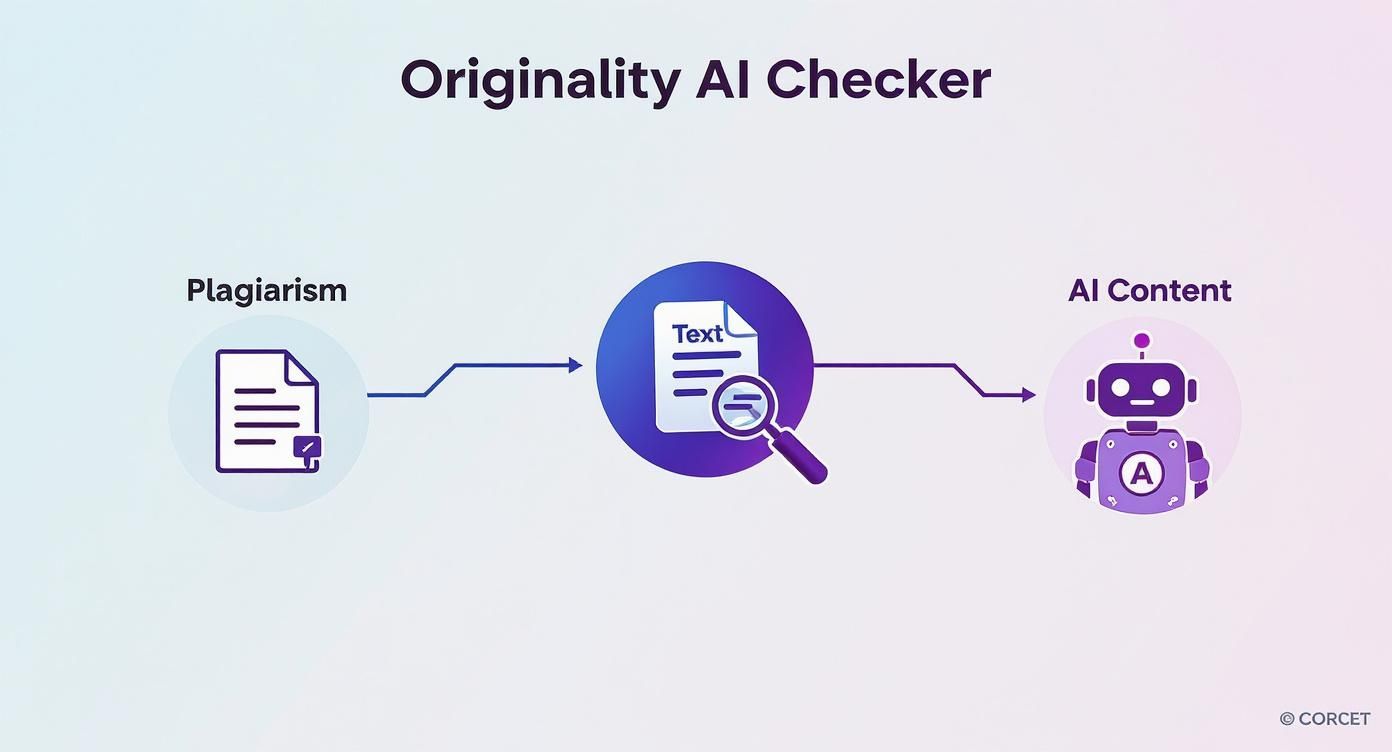
As you can see, the work involves looking at the text through two different lenses—one for copied content and another for those machine-like patterns—to figure out its true origin.
Learning from a World of Text
The "brain" of an originality AI checker is built by feeding it massive libraries of text. We’re talking millions of articles, books, and essays written by humans, alongside countless examples of content produced by different AI models. Through this huge learning process, the checker gets really good at spotting the unique "fingerprints" of each writing style.
This is where two key ideas, perplexity and burstiness, come into the picture. They sound a bit technical, but they're easy to wrap your head around.
- Perplexity: This is all about how surprising or unpredictable word choices are. Human writing usually has a higher perplexity because we use odd phrases, idioms, and unexpected words. AI, on the other hand, often just picks the most statistically likely next word, which makes its writing smooth but also very predictable.
- Burstiness: This looks at the variety in sentence length and structure. Humans naturally write in bursts—you might see a short, punchy sentence followed by a long, descriptive one. AI writing often has a much more uniform rhythm, with sentences that are all pretty similar in length and complexity.
A low perplexity score often points to text that is straightforward and predictable—a common trait of AI-produced content. A high score suggests more complex and varied language, which is typical of human writing.
Analyzing the Patterns
When you pop a piece of text into an originality AI checker, it breaks it down and measures it against all those patterns it has learned. It's not just hunting for copied sentences; it's examining the very fabric of the writing. The tool is essentially asking a series of questions:
- How consistent is the sentence structure?
- Is the vocabulary rich and varied, or does it lean on common words?
- Does the writing flow naturally, or is it a little too perfect?
By piecing together the answers, the checker assigns a score that shows the likelihood that the text was written by a machine. If you're curious about the more technical side of things, our guide on how AI detection tools work takes a much deeper look into the mechanics.
The goal isn't just to catch AI, but to truly understand the little details that make writing feel authentic. This is why for so many creators, the final step in their workflow is refining AI-assisted drafts to make sure they connect on a human level. A top-tier tool like Word Spinner is built for exactly this, helping to humanize content, smooth out any robotic tones, and guarantee the final piece is both original and engaging.
Why Content Authenticity Matters Now More Than Ever
Let's be honest, the explosion of AI has unleashed a tidal wave of content. Articles, blog posts, social media updates—it's everywhere. This has made it incredibly tough to know what was written by a person and what was produced by a machine. This isn't just a minor headache; it's a direct challenge to how we trust anything we read online.
This uncertainty isn't just theoretical. It has real consequences. If you're in SEO or content marketing, the rules of the game have completely changed. Search engines are getting much better at figuring out what content is genuinely helpful and written for humans. Genuineness is no longer just a nice-to-have; it's a cornerstone of building authority and climbing the search rankings.
News organizations are on the front lines, too. Their entire reputation is built on trust. In an age where fake news and misinformation can go viral in minutes, being able to verify where content comes from is absolutely critical. For them, using an originality AI checker isn't just good practice—it's essential for maintaining journalistic integrity.
The Global Push for Transparency
This problem hasn't gone unnoticed. All around the world, governments and major tech companies are starting to step in, creating a new reality where being upfront about AI-produced content is becoming the norm.
We're seeing a clear move toward new rules and standards:
- New Labeling Rules: There's a big push to require clear labels on AI-produced content, so people know exactly what they’re looking at.
- Platform Policies: Tech giants are baking new policies into their platforms to better identify and manage content created by machines.
- Specialized Tools: To meet this new demand, a whole industry of tools for fact-checking, plagiarism scanning, and AI identification has sprung up.
The question of content genuineness has become a critical issue, driven by the explosion of AI tools and synthetic media. This has sparked a global response aimed at preserving trust and transparency online.
This shift really highlights a fundamental change in how we have to think about digital content. The days of just hitting "publish" and walking away are long gone.
Why Originality Is Now a Credibility Signal
In this new environment, checking for originality is about so much more than just catching plagiarism. It has become a direct signal of your credibility.
When you take the step of verifying your content’s genuineness, you’re sending a clear message to your audience: you value their trust and you’re committed to giving them information they can rely on.
The rise of synthetic media has also prompted some serious regulatory action. The EU AI Act, for example, now has rules for labeling deepfakes, and other countries are looking at big fines for unmarked AI content. You can get a deeper dive into how tech giants and specialized tools are handling this in this detailed authenticity report.
In the end, the need for an originality AI checker has moved from the classroom to the boardroom. It’s now a vital piece of modern communication, helping everyone maintain trust in a world where it’s incredibly easy to create content, but increasingly hard to believe it.
Real-World Uses For Originality AI Checkers
An originality AI checker isn't just some niche gadget for tech geeks anymore. It’s become a crucial part of the daily grind in all sorts of fields. From university lecture halls to corporate marketing suites, people are leaning on these tools to protect their standards, safeguard their reputations, and just plain make sure the content they’re putting out is theirs. The applications are surprisingly broad, touching just about anyone who writes or manages content for a living.
Let's ground this in reality. Picture a university student, bleary-eyed, putting the final touches on their thesis. After months of painstaking research, the last thing they need is to be accidentally flagged for unoriginal work. A quick run through a checker gives them that final dose of confidence, confirming their citations are on point and their own voice shines through.
Or think about a content manager at a fast-growing startup. They’re juggling a team of freelance writers to keep the blog fresh. To protect the company's hard-won SEO rankings and credibility, that manager runs every single submission through a checker. It’s a simple step that verifies the articles are not only plagiarism-free but also sound genuinely human—keeping the brand’s voice consistent and authentic.

Safeguarding Academic and Educational Integrity
Nowhere is the impact of these tools more obvious than in education. With students naturally turning to AI for help with their assignments, schools are in a tough spot. They need a reliable way to uphold academic honesty, and an originality checker is the perfect tool to help educators confirm that student submissions are the product of actual learning, not just a clever prompt.
This isn't just a minor trend. In its first year with an AI checker, a single major service—Turnitin—scanned over 200 million papers. The findings? Roughly 11% of them had at least 20% AI-produced text. That shows you just how common AI assistance has become. Globally, around 86% of students admit to using AI tools for their studies, which has prompted a massive uptick in adoption by teachers. To see how these tools are being used on campus, check out this guide on the AI detection system for schools.
In just one academic year, the use of these checkers by educators shot up from 38% to 68%, a clear sign of the urgent need to address AI's role in the classroom. You can dig deeper into these numbers by reading up on the latest AI detection tools stats and trends.
Protecting Brand Reputation and SEO
For businesses and content creators, originality is the name of the game. A brand’s voice is its identity. Pushing out content that sounds robotic or recycled is a surefire way to kill reader trust. That's why marketing teams use checkers to make sure every blog post, landing page, and email—whether written in-house or by a contractor—hits their quality bar.
Here’s a snapshot of who relies on these tools and why.
| User Group | Main Goal | Example Use |
|---|---|---|
| Students & Academics | Ensure academic integrity and proper citation. | Running a thesis through a checker before submission. |
| Content Managers | Maintain brand voice and SEO health. | Vetting blog posts from freelance writers for AI content. |
| SEO Specialists | Avoid penalties for duplicate or low-quality content. | Auditing website content for uniqueness. |
| Publishers & Editors | Uphold editorial standards and author credibility. | Screening manuscripts for unoriginal passages. |
| Individual Bloggers | Build reader trust with an authentic voice. | Checking their own drafts to improve AI-assisted writing. |
As you can see, the core motivation is always about ensuring authenticity and quality, no matter the context.
Here are a few key uses in the business world:
- Vetting Freelancer Submissions: Managers can quickly check articles from outside writers for both plagiarism and AI writing.
- Maintaining SEO Health: Search engines reward unique, helpful content. Verifying originality helps avoid penalties associated with duplicate or low-quality material.
- Preserving Brand Voice: A checker helps make sure all published content sounds authentic and human, reinforcing the brand's personality.
Even if you use AI to brainstorm or hammer out a first draft, the real work is improving that output until it feels completely natural. A powerful tool like Word Spinner is built for exactly this, excelling at humanizing text to smooth out any robotic patterns. This makes sure the final piece not only connects with your audience but is also 100% plagiarism-free.
In essence, originality checkers serve as a quality control checkpoint, making sure that all public-facing content is authentic, credible, and valuable to the audience.
From upholding editorial standards at major publishing houses to helping individual bloggers build a loyal following, the practical value of confirming where content comes from is undeniable. Each use case demonstrates a commitment to quality and transparency in a crowded digital world.
How to Choose a Tool and Understand Its Results
With so many originality AI checkers on the market, picking the right one can feel like a chore. The real goal is to find a tool that slots perfectly into your workflow, whether you're a student trying to stay on the right side of academic integrity, a content creator, or a business. But picking the tool is only half the battle—you also have to know what the report is actually telling you.

First things first, you need to decide what you need the checker to do. Some tools are fantastic at sniffing out old-school plagiarism but aren't so sharp when it comes to identifying AI writing. Others are the complete opposite. A truly solid originality checker handles both, giving you a complete view of your content's genuineness.
Key Factors in Selecting an Originality Checker
When you start comparing tools, it's easy to get lost in the marketing hype. My advice? Zero in on the practical stuff. A checker that's a nightmare to use or spits out confusing reports is just going to slow you down.
Here are the big things to look for:
- Dual Functionality: Does the tool reliably check for both traditional plagiarism and AI-produced text? This is a must-have for any modern originality checker.
- Ease of Use: Is the interface clean and simple? You should be able to drop your text in and get a clear report without having to read a manual.
- Report Clarity: How does the tool show you the results? The best ones use clear highlighting, side-by-side comparisons, and scores that make instant sense.
For writers who are serious about creating genuinely human content that sails through these checks, a high-quality rewriter can be a game-changer. A tool like Word Spinner is built to polish text by removing robotic AI patterns, guaranteeing it’s 100% plagiarism-free while sounding natural and engaging.
Making Sense of the Results
So, you've run your text through a checker and have a report. You'll probably see a percentage score that shows the likelihood of AI-produced content. It's crucial to remember this number isn't the final word. Think of it more like a helpful signal or a guidepost, not a final judgment.
An AI score should be the start of a quality review, not the end of it. Use it as an indicator to investigate further, but always apply your own human judgment.
These tools are incredibly useful, but they aren't flawless. Sometimes, perfectly human writing—especially if it's very direct or formal—can get flagged by mistake. This is called a "false positive," and it’s why the checker should only be one part of your quality control process.
If you want to get into the weeds on this, our guide on which AI detector is most reliable breaks down the pros and cons of different options.
So, what do you do when a high AI score pops up?
- Review the Highlighted Sections: Take a minute to manually read the parts the tool flagged. Do they sound a bit lifeless or robotic? Is the voice missing?
- Consider Your Writing Process: Be honest. Did you write this from scratch, or did you rely heavily on an AI assistant to do the heavy lifting?
- Rewrite and Improve: If some sentences or paragraphs do feel stiff, see it as an opportunity. This is your chance to rewrite them, inject more of your own personality, mix up the sentence structures, and add some special insights.
At the end of the day, an originality AI checker is best used as a partner in your writing process. It helps you catch potential weak spots so you can improve your work, making sure it connects with your audience and meets the highest standards of originality.
Frequently Asked Questions
Even after getting the hang of what originality AI checkers are all about, you probably have a few questions floating around. Let's tackle some of the most common ones to clear up any confusion.
Can An Originality AI Checker Be 100 Percent Correct?
Nope, and it's super important to understand their limits. While these tools are getting incredibly good at sniffing out the typical patterns of AI-written text, they aren't flawless. They can sometimes make mistakes, leading to a "false positive" (flagging your human writing as AI) or a "false negative" (missing content that was actually written by AI).
It's best to treat these tools as a strong guide, not a final, absolute verdict. You always need to apply your own judgment when you see the results, especially when the stakes are high in school or at work. A score from an AI checker should be the start of a conversation about content quality, not the end of it.
A common mistake is thinking AI checkers give a simple "yes" or "no" answer. What they actually do is give a probability score based on patterns they've learned, which always needs a human to interpret it correctly.
For example, seeing a score of 80% AI doesn't automatically mean a robot wrote the text. It just means the writing style closely matches the patterns the tool was taught to see as AI-like. This is your cue to take a closer look at the flagged text for things like a robotic tone or sentences that sound way too predictable.
What Should I Do If My Writing Is Flagged As AI-Generated?
First things first: don't panic. If you wrote the content yourself, this is actually a good opportunity to sharpen your writing style. Start by looking at the exact parts the tool highlighted. Sometimes, writing that is extremely simple, direct, or overly formal can trigger a tool because it doesn't have the natural flow and variation of human expression.
Here are a few steps you can take:
- Add Your Voice: Try rewriting the flagged sections to inject more of your personality. Mix up your sentence lengths and structures to give your writing a more natural rhythm.
- Keep Your Drafts: It's always a smart move to hang on to your notes, outlines, and early drafts. If you ever need to, these can help show your writing process.
- Check Your Process: If you used an AI tool to help with brainstorming or an outline, double-check that the final text is completely in your own words and truly reflects your voice.
The real goal is to make sure the writing sounds like it came from you.
How Do AI Checkers Affect SEO?
Search engines like Google are focused on one thing: giving people high-quality, helpful, and original content made for humans. While they don't have a direct penalty just for using AI, they absolutely penalize low-quality, spammy, or unoriginal content—which is often exactly what you get from mass-produced AI articles.
Using an originality AI checker is actually a really smart move for your SEO for a few reasons:
- It helps you make sure your content is special and won't get flagged for plagiarism or being a duplicate of something else.
- It pushes you to create content that feels authentic and trustworthy, which is precisely what search engines want to rank higher for their users.
- Publishing original, valuable content consistently is the foundation of any solid SEO effort.
Think of it as a quality control step that makes sure your content meets the high standards that search engines—and your readers—expect.
Are There Ways To Make AI Content Go Unnoticed?
Sure, there are tools and methods designed to rewrite AI text to make it sound more human and slip past checkers. This usually involves messing with sentence structures, swapping common words for less common ones, and changing the rhythm of the text to break up the predictable patterns an originality AI checker is trained to find.
But the best and most ethical way to handle this is to use AI as your assistant. Let it help with ideas, research, or a rough first draft, but then you need to do a thorough rewrite in your own authentic voice. Your focus should always be on making amazing, valuable content for your audience, not just trying to fool a piece of software.
After all, the best content feels genuinely human because a real person put real thought, care, and personality into it.
Ready to create content that is authentic, engaging, and passes every check with confidence? Word Spinner offers rewriting and humanizing tools to ensure your text is 100% original and connects with your audience. Discover how it can transform your writing process at https://word-spinner.com.