How to Rewrite an Essay Without Plagiarizing: A Practical Guide

To rewrite an essay without plagiarizing, you need to do more than just swap out a few words. It's a much deeper task. It means you truly understand the original material, completely break down and rebuild sentences and paragraphs, and then put the core ideas back together in your own voice—all while giving credit where it's due.
Understanding Where Rewriting Ends and Plagiarism Begins
Before you can tackle a rewrite with confidence, you have to know where the line is between good paraphrasing and academic dishonesty. This is very important.
A common trap is just using a thesaurus to change a few words in a sentence. This is called "patchwriting," and modern plagiarism checkers can spot it easily. The real goal isn't to hide the source; it's to process the information so well that you can explain it to someone else from scratch.
This means the very structure of your sentences and the flow of your arguments have to be yours. If the original text laid out three points in a certain order, your version needs to shuffle those ideas or frame them in a new way. It's about showing you've done more than just trace over a template. For a deeper look, exploring different ways to prevent plagiarism can build a much stronger foundation for your writing habits.
Spotting Plagiarism in Its Different Forms
Not all plagiarism is a simple copy-paste job. There are more subtle forms you need to be aware of and actively avoid:
- Mosaic Plagiarism: This is when you pick phrases and sentences from different sources and weave them together without using quotation marks or proper citations. It creates a "mosaic" of borrowed text that might look original at first but isn't.
- Self-Plagiarism: Yes, you can plagiarize yourself. Reusing big chunks of your own work that you've submitted for another class without your instructor's permission is a form of academic misconduct.
- Incorrect Attribution: Even if you try to cite your source, getting the details wrong or failing to credit the idea properly can still get flagged as plagiarism. Good intentions don't always save you here.
To help picture the difference between doing it right and getting it wrong, I've put together a quick comparison table.
Rewriting Techniques Original vs Plagiarized
| Technique | What It Looks Like (Original) | What It Looks Like (Plagiarized) |
|---|---|---|
| Paraphrasing | Reading a paragraph, putting it aside, and writing the main idea entirely in your own words and sentence structure. | Swapping out a few keywords with synonyms but keeping the original sentence structure and flow. |
| Summarizing | Condensing a long article into a few sentences that capture the main argument, citing the source of the idea. | Copying key sentences from different sections and piecing them together without quotation marks. |
| Quoting | Using quotation marks for an exact phrase and providing a clear citation right after. | Including an exact phrase from a source without quotation marks, even if you cite it later. |
| Attribution | Citing the source for any idea, statistic, or concept that is not common knowledge or your own original thought. | Mentioning an idea from a source but failing to include a specific citation, making it seem like your own. |
This table shows that originality is all about the process—how you work with and change information—not just the final words on the page.
The flowchart below breaks it down even further, showing how the path of originality leads to academic integrity, while the shortcuts of plagiarism lead to serious consequences.
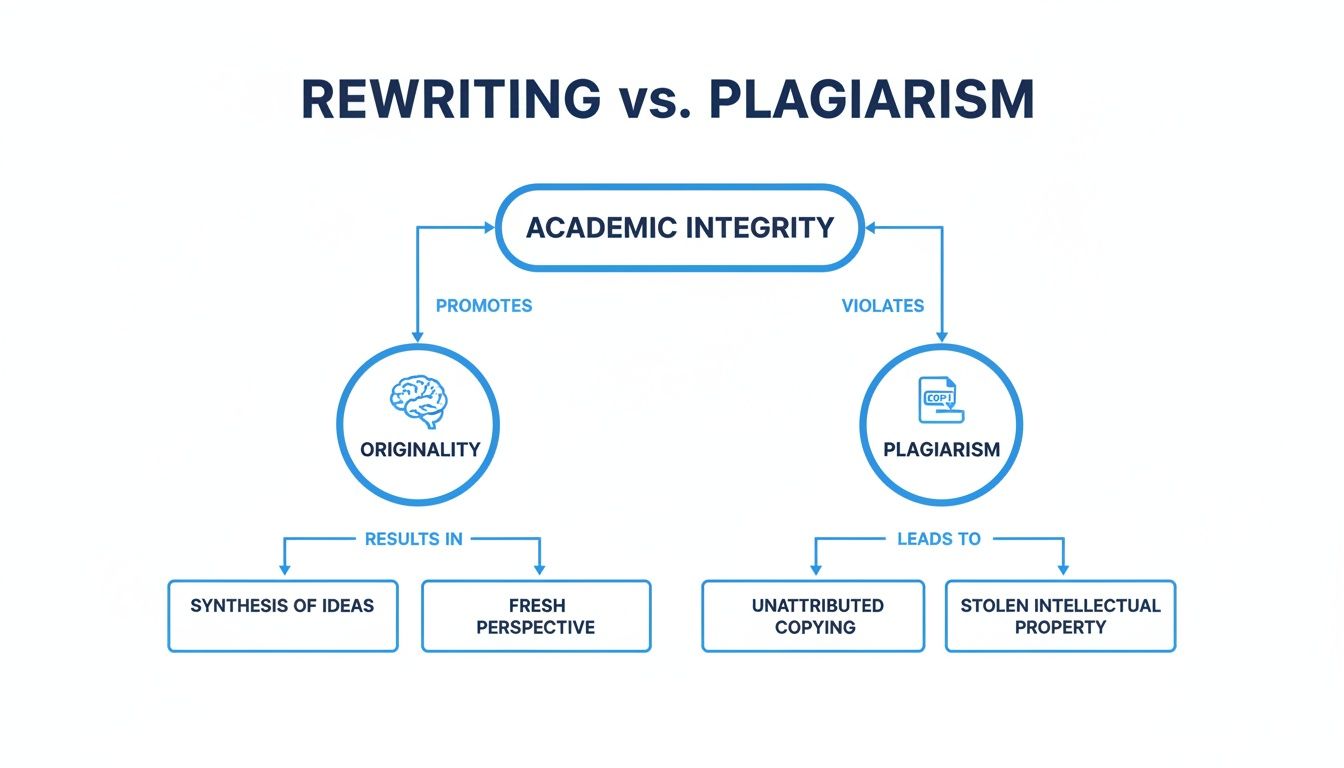
In the end, true originality comes from internalizing ideas and making something new from them. Plagiarism, in any form, is really just about copying—whether it's the language, the structure, or the core idea without credit.
A Practical Method for Manual Rewriting
To truly rewrite an essay without plagiarizing, you need a hands-on method that goes beyond just swapping out a few words. The real goal is to get so familiar with the source material that you can explain it in your own voice, using a completely new structure. This isn't just about dodging penalties—it’s about actually understanding the subject on a deeper level.

It all starts with deep reading. Don't just skim the original text. Read it over and over until you can confidently summarize its main arguments without even looking at it. Once you’ve got the ideas down, put the source material away. I mean it—hide it. This step is a must because it creates the distance you need to avoid accidentally copying phrases or ideas.
Next, start taking notes purely from memory. Jot down the key ideas, arguments, and supporting points in your own words. This action forces you to filter the information through your own viewpoint, which is the first real step toward originality. These notes are what you'll use to build your new essay.
Creating a New Structure
With your memory-based notes in hand, it's time to create a fresh outline. The last thing you want to do is follow the original essay's flow. Instead, ask yourself what the most logical way to present this information to your reader is.
- Group related ideas: Look at your notes and start combining ideas into new themes or sections.
- Rearrange the argument: Think about starting with a completely different point than the original author did.
- Add your own thoughts: Where can you put in your own analysis or connect ideas in a new, interesting way?
When you’re tackling a manual rewrite, using an essay plan template can be a huge help in keeping the work organized and making sure your structure stays original. Once that outline is solid, start writing your first draft using only your outline and notes. Keep that original source hidden! This forces you to rely entirely on your own understanding and writing style.
The real secret to a successful manual rewrite isn't just about changing words. It's about changing the very architecture of the argument, making sure the final piece is structurally and stylistically your own.
The pressure to produce original work is immense, especially in today's crowded digital space. With the global entertainment and media sector hitting $2.9 trillion in revenues, there's a surge of creators out there where plagiarism risks are a major concern. For writers and academics, this environment makes solid manual rewriting skills more critical than ever.
The key is to practice these manual steps until they become second nature. You'll build your confidence and your skill as a writer every time you do it.
Using Rewriting Tools the Smart Way
Let's be real—rewriting tools can feel like a magic button when you're on a deadline. But using them blindly is a surefire way to get robotic-sounding text that might still get you flagged for plagiarism.
The trick is to see these tools as a writing partner, not a replacement for your own brain. They’re there to help you find new ways to phrase ideas you already get, not to do the hard work for you.
A weak tool will just swap out words for synonyms, often leaving you with awkward sentences that don’t quite make sense. A quality platform, on the other hand, can help you tweak the tone, simplify complicated ideas, and make sure everything flows naturally. Think of it as a team effort; you bring the core ideas, and the tool helps you dress them up in a new outfit. For some great information on the ethical side of this, check out the role of responsible AI in writing.
Choosing and Using Your Tool Effectively
When you need to rewrite an essay without plagiarizing, the tool you pick makes all the difference. You need something that goes beyond basic word replacement. Look for options that can genuinely humanize the text so it sounds like something a person actually wrote.
For instance, a leading tool like Word Spinner is built to do more than just rephrase. It’s designed to create natural, human-like content that is guaranteed to be 100% plagiarism-free while also removing AI detection patterns. This is what separates a helpful assistant from a risky shortcut. You can dive deeper into the differences by reading our guide on the best free AI tool for paraphrasing.
Having control over the output is key. A good workspace will let you input text and select specific functions like tone adjustment or humanization, letting you fine-tune everything to match your original meaning and style.
The smartest way to use any rewriting tool is to feed it a draft you've already written from your own notes. This makes sure the core structure and ideas are yours. The tool's job is then to polish and improve, not to create from scratch.
Once the tool gives you a new version, your job isn’t over. Read through it carefully. Does it still get your original message across? Does it flow well? Now’s the time to make manual edits, fix any clunky phrasing, and make sure the final piece is something you're proud to call your own.
The Final Polish: Checking Your Work for Originality
You’ve put in the hard work of rewriting your essay, but don't close the document just yet. The final step is all about checking—making sure your work is genuinely original and ready to submit.
Think of this as your last line of defense. Skipping it is like building a house and forgetting to inspect the foundation.
First things first, run your finished essay through a reliable plagiarism checker. When you get the report, don’t just look at the overall percentage. You need to dig into the details and see what, specifically, got flagged.
Sometimes, the tool will highlight common phrases or properly cited quotes, which is usually nothing to worry about. But other times, it'll point out sentences that are still a bit too close to the source material. Those are the spots that need your immediate attention.
Making Final Revisions
If the checker flags a section, it's time to go back to your notes and the original source one last time. The goal here isn't just to swap out a few more words; it's to rephrase the entire idea from the ground up, using your own understanding.
Here are a couple of tried-and-true tricks I use:
- Read it Aloud: This feels simple, but it works very well. Reading your essay out loud helps you catch awkward phrasing and sentences that sound robotic. Your ears will often notice what your eyes miss.
- Compare with Your Notes: Pull up your initial, memory-based notes and do one final comparison. Does the final essay still reflect the unique structure and understanding you mapped out at the beginning?
The point of a final check isn’t just to hit a low plagiarism score. It’s to make sure the essay’s voice, structure, and flow are unmistakably your own. It should show true comprehension, not just clever rephrasing.
The demand for truly original content has never been higher. Just look at the marketing world, where creator marketing investments have jumped by 143% since 2021. This trend puts immense pressure on everyone, from students to professionals, to produce authentic work.
With 43% of marketers now using AI for content creation, the risk of accidentally producing duplicate text is a real concern, which makes these final originality checks more critical than ever. You can discover more insights about these marketing trends to see just how much value is being placed on authenticity.
Mastering Citations and Attribution
Properly citing your sources isn’t just some academic hoop to jump through; it's a vital part of credible writing. Think of citations as the backbone of your entire argument. They prove you've done your homework and give your readers a clear trail to follow, building trust with every single reference you include.
Even a brilliantly rewritten essay can get flagged for plagiarism if you drop the ball on attribution. The bottom line is simple: give credit where it's due for any idea, statistic, or piece of info that isn't your own original thought. This goes for direct quotes, paraphrased ideas, and even summaries of someone else's work.
What to Cite and When
Figuring out what needs a citation can feel a bit murky at times, but here’s a rule of thumb I’ve always found helpful: if you had to look it up, you should probably cite it. The only real exception is common knowledge—facts that are so widely known you could find them in any general encyclopedia (e.g., "The Earth revolves around the Sun").
Here's a quick breakdown:
- Direct Quotes: Always, always wrap these in quotation marks and add a citation. No exceptions.
- Paraphrased Ideas: Just because you put it in your own words doesn't make it your idea. You still need to credit the original source.
- Data and Statistics: Numbers, figures, and any kind of data must be attributed.
- Unique Theories or Concepts: Give a nod to the original thinker who came up with the idea.
The digital content world is absolutely massive, with the creator economy now valued at over $250 billion. Within this space, a huge 92% of brands are demanding authentic, plagiarism-free work. This makes proper attribution a must-have skill for everyone from students to professional writers. You can discover more insights about content creator statistics to see just how high the stakes are.
Forgetting even one citation can undermine your entire essay. Trust me, it’s always better to over-cite than to leave your reader guessing where an idea came from.
The best habit you can build is managing your sources right from the start. Keep a running list of every article, book, or website you look at, and jot down which ideas came from where. Getting comfortable with different citation styles is also key. For a deep dive, check out our complete citation format guide to get the hang of APA, MLA, and more.
Common Questions About Rewriting Essays
When you're trying to rewrite an essay without plagiarizing, a lot of questions can pop up. It’s a tricky area, so let’s walk through some of the most common ones I hear to get you some clear, straightforward answers.
Is It Okay to Rewrite Someone Else's Essay?
The short answer is yes, but only if you approach it the right way. Rewriting another person’s work is only acceptable if you treat it as a deep paraphrasing exercise and—this is the crucial part—cite every single idea you borrow from the original.
Just swapping out a few words here and there is a fast track to academic trouble. You need to completely overhaul the sentence structures and use your own vocabulary. Most importantly, you have to give full credit to the original author for their ideas. Trying to pass off a rewritten essay as your own original work without proper citations is plagiarism, period.
How Much of an Essay Must I Change to Avoid Plagiarism?
This is a classic question, but there’s no magic number. Instead of focusing on a percentage, your goal should be to genuinely show your own understanding of the material.
Here’s a technique I’ve always found helpful: read the original source, then put it away completely. I mean, out of sight. Now, try to write about the ideas from memory. This simple trick forces you to use your own phrasing and structure because you aren't staring at the source text. And remember, even if you rephrase something perfectly, any unique idea, statistic, or piece of data that isn't yours still needs a citation.
Can Plagiarism Checkers Detect Rewritten Content?
Absolutely. Today's plagiarism checkers are very advanced and can easily spot rewritten text, especially if it's just a lazy word-swap job. They don’t just look for identical phrases; they analyze sentence patterns and the flow of ideas, comparing them against massive online databases.
This is exactly why a deep, meaningful rewrite is so critical. You have to change the fundamental structure of the arguments, not just the paint on the walls. Superficial changes are easy for these tools to flag.
This is also where a good rewriting tool can be a huge help. The best ones assist you in creating something genuinely new and restructured, making it far less likely to trigger a plagiarism flag. The key is to use tools that help you create, not just disguise.
For a reliable way to make sure your rewritten essays are original and sound natural, take a look at Word Spinner. It’s built to create 100% plagiarism-free content that reads like a human wrote it, giving you real confidence in your work.