The complete guide to AI checker french

You wrote a cover letter in French, ran it through ChatGPT, and now you are staring at a tool that says it is 92 percent AI-generated. The job application is fine, but you cannot send it like that, and you are not sure which checker to trust or what the score even means.
For most writers, Word Spinner offers the most practical balance of detection and rewriting tools, and we will show you why.
Key takeaways
- Verify every flagged text manually: AI checkers for French content are probabilistic, so a high score alone is not proof of AI authorship.
- Check short texts twice: detection accuracy drops sharply on anything under 150 words, so run short passages through a second tool.
- Keep your original drafts: saving your French writing history is the only way to defend a false positive.
- Match the tool to the model: some checkers specialize in ChatGPT output, while others cover Mistral and Gemini, so pick one that fits your source.
What is the best AI checker for French text?
Word Spinner is the best AI checker for French text because it combines AI detection with a built-in humanizer, so you can verify a text and fix it in one place without switching tools. It works on ChatGPT, Mistral, and other French AI outputs, and the free tier requires no signup. For a dedicated detector with a different focus, QuillBot's French AI checker is a strong alternative if you only need detection and already use QuillBot for rewriting.
Detection alone rarely solves the problem; you usually want to rewrite the flagged text afterward, which is why Word Spinner wins for most writers.
How an AI checker for French text actually works
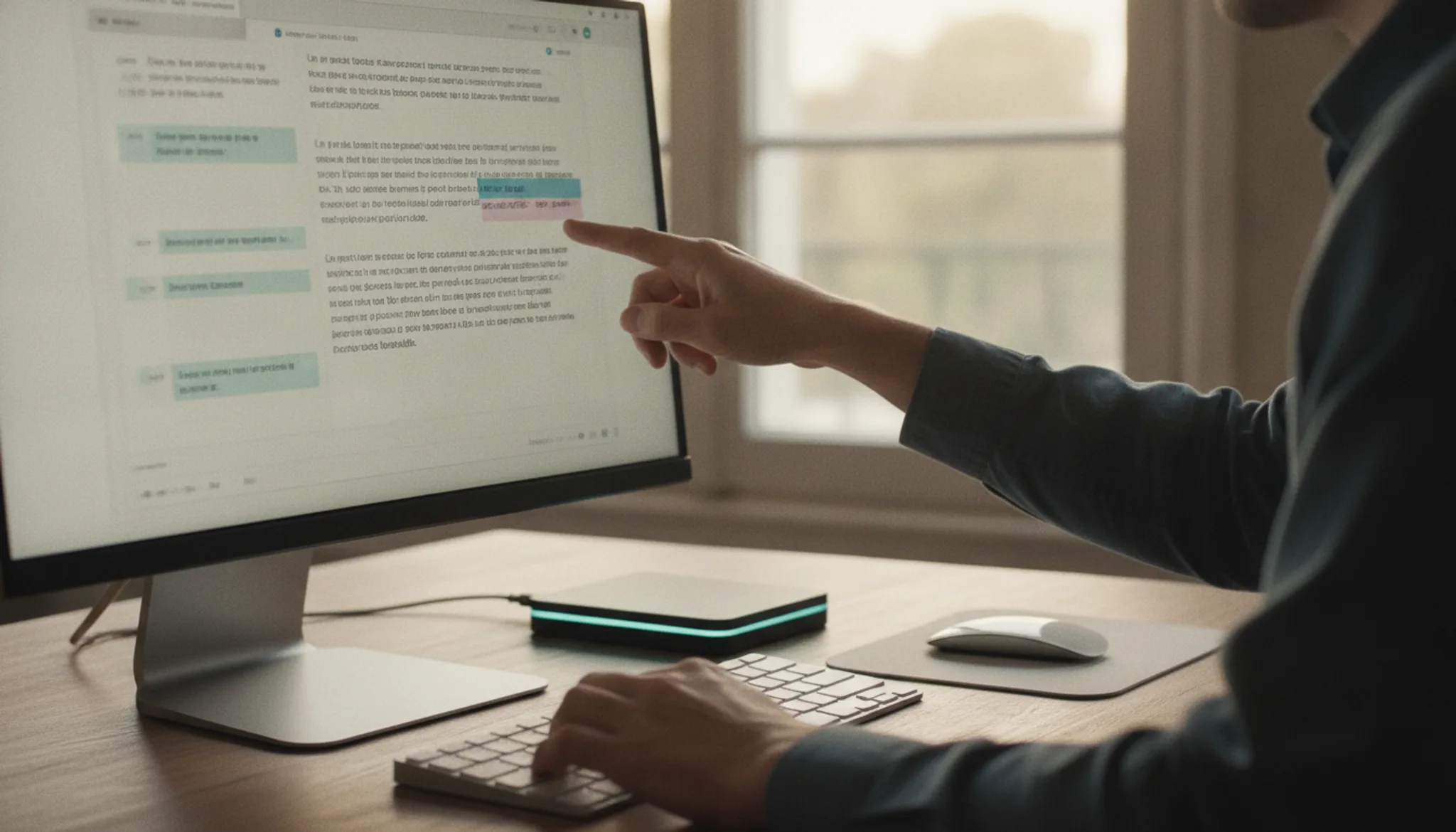
An AI checker for French text is a detection tool that analyzes written French to estimate whether a human or an AI model like ChatGPT produced it.
The mechanism matters because French detection differs from English. French grammar and word order create different statistical fingerprints, so tools trained mainly on English data often misclassify French academic or formal writing as AI-generated. That is why specialized French detectors exist, such as Lucide.ai and ZeroGPT Plus, which tune their models on French corpora.
No checker gives a definitive verdict. The score is a probability, not proof, so you should always read flagged passages yourself before acting on the result.
What happens when you run French text through an AI checker?
Running French text through an AI checker produces a probability score, not a verdict. The tool compares your text against patterns common in machine-generated French, then reports a percentage that estimates how likely an AI wrote it.
The score comes from analyzing several signals at once. Perplexity measures how predictable each word is in context; AI tends to pick the most statistically likely next word, while humans make less predictable choices.
A 90 percent score does not mean ChatGPT produced the text. It means the text shares statistical traits with AI-generated French. Short, factual sentences in formal French often trigger false positives because they look predictable. Conversely, a human can edit AI output enough to drop the score below typical thresholds.
That is why the practical workflow is verify, then decide. Run the text through a checker, read the flagged passages yourself, and judge whether the phrasing actually sounds machine-made before you act on the number.
How to check French text for AI in five steps
Checking French text for AI authorship takes about two minutes when you follow a fixed sequence. Here is the workflow that catches the most false flags.
- Copy the raw text: Paste the French passage into the checker exactly as it appears, including headings and bullet points. Removing formatting changes how the tool scores the text.
- Run the detection: Submit the text and wait for the probability score. A result above 70 percent AI-generated means the model found strong statistical patterns typical of ChatGPT and similar tools.
- Read the flagged sentences: Most checkers highlight the specific lines they suspect. Look at those passages yourself. French academic and formal business writing often triggers false positives because it follows predictable structures.
- Verify with a second tool: Cross-check borderline results on a different detector, such as isgen.ai. Two tools agreeing on a score above 80 percent is far more reliable than one alone.
- Humanize if you need to publish: When the text must pass as human-written, run it through the Word Spinner humanizer, then re-check the output. A good humanizer should drop the AI score below 20 percent while keeping the French natural.

What features matter most in an AI checker for French?
The features that matter most in an AI checker for French text are language accuracy, a clear probability score, and a way to act on the result.
Language accuracy is the first thing to verify. French has gendered nouns, complex verb conjugations, and regional variations, so a checker trained mostly on English will misfire on common French constructions. Look for tools that explicitly advertise French support, like Lucide.ai or ZeroGPT Plus.
A probability score with context beats a simple yes or no. The best checkers show a percentage per sentence, so you can see which passages triggered the flag rather than reworking your whole document.
A built-in fix separates useful tools from dead ends. Word Spinner pairs detection with a humanizer, so you can verify French text and rewrite flagged sections in one place.

Real-world uses for an AI checker on French text
An AI checker for French text earns its place in three everyday situations: reviewing a cover letter before sending it, checking a student essay for undisclosed AI help, and verifying translated marketing copy that will appear on a public site.
The practical pattern is to check early, not at the last minute. A cover letter that scores high on AI detection can be rewritten and rechecked in the same session, which is where a tool like Word Spinner helps because its humanizer sits next to the detector.
For marketing copy, run the check before translation goes live, and pair it with a grammar check so the final text reads naturally in both languages.
Best practices for using an AI checker on French text
Use an AI checker on French text as a screening tool, not a final judge.
Run the same text through two different checkers when the result matters. French detection accuracy varies between tools, and a second opinion helps you spot a false positive before you act on it.
Keep the original version of any text you check. Comparing the flagged passage against your draft shows you exactly which sentences triggered the score, which is more useful than the number alone.
Check the text again after you edit it. Rewriting flagged passages usually changes the score, so verify your revision before you send the final version. For a closer look at how detection percentages behave in practice, see these practical examples of AI checker percentages and this comparison of reliable AI checker alternatives.

AI checkers for French text compared side by side
The four options below differ mainly in what you do after detection. Compare them on three criteria: best use, strength, and limitation.
| Option | Best for | Key trade-off |
|---|---|---|
| Word Spinner | Checking and rewriting in one pass | Detection plus humanizer, but Pro pricing applies for unlimited use |
| Quillbot | Quick checks on short French passages | Free tier limits how much text you can scan |
| ZeroGPT Plus | Verifying French academic submissions | High accuracy, yet no built-in rewrite option |
| Smodin | Bulk checking of longer documents | Strong volume handling, weaker on short informal text |
Verified August 2026
Why AI checkers for French text can mislead you
An AI checker for French text gives you a probability, not proof, and that distinction matters more than most people realize.
The reverse also happens. A student who rewrites an AI draft heavily, adding personal anecdotes and irregular sentence lengths, can push the score down into the human range. The checker measures resemblance, not authorship.
Three specific failure modes are worth knowing before you rely on any result:
- False positives on formal French: Administrative writing, academic abstracts, and business correspondence use predictable structures that overlap with AI output.
- False negatives on edited text: Light human editing, even changing a few verbs, can drop the score below a detection threshold.
- Inconsistent results across tools: The same paragraph can score 85 percent on one checker and 40 percent on another, because each model weights different features.
Treat the score as a signal to read the text closely, not as a verdict you can act on alone.
Frequently asked questions about AI checkers for French text
Can an AI checker detect French text written by ChatGPT?
Yes, most AI checkers for French text can flag content produced by ChatGPT, but the accuracy varies by tool and by text length.
Do AI checkers work the same way for French as they do for English?
No, French detection is generally less reliable than English detection because AI models learned from far more English text. French has its own grammar patterns, gendered nouns, and verb conjugations that change how a detector reads the text.
What should I do when a French text is flagged as AI-generated?
Treat the flag as a signal to review the text manually, not as proof of AI authorship. Read the flagged passages closely for unnatural phrasing, repetitive sentence openings, or overly formal transitions that feel mechanical.
Can I use an AI checker on French academic work?
You can, but universities often use their own detection systems, so a third-party checker result is not an official finding. If you are a student, check your institution's policy on AI tools before relying on any detector.
Is there a free way to check French text for AI?
Yes, several AI checkers for French text offer free tiers, including Word Spinner, which lets you run basic checks without signing up.
Final verdict on AI checkers for French text
If you need to verify French text for AI authorship, Word Spinner is the practical choice: it pairs detection with a built-in humanizer, so a flagged passage can be reworked in the same place. That combination saves you from juggling two tools when a document comes back with a high AI probability.
Choose differently only when you need a strict audit trail for academic or legal review. In that case, a dedicated detection-only service gives you clearer documentation of the check itself.
Your next step is simple: run one real French paragraph through Word Spinner and judge the result against your own reading.