A Guide To Translation English To Albania That Gets It Right

Thinking of translating your content from English to Albanian? It’s about much more than just swapping out words. To truly connect, you have to nail the meaning, feeling, and cultural details that build real trust with your audience. This is essential whether you're targeting markets in Albania, Kosovo, or the wider Albanian community.
Why Good English To Albanian Translation Matters
Simply running English text through a basic converter often backfires. Why? Because the little things that make communication feel human get lost. Idioms, humor, and cultural references almost never translate directly. A perfectly normal English phrase can easily come across as awkward, unprofessional, or even offensive if it’s not localized properly.
This is where true localization comes in. It’s the art of adapting your message to fit the local culture, making sure it hits home on a much deeper level. Without this step, your message can fall flat, damaging your brand's credibility before you've even had a chance to make an impression. For a deeper look at this, our guide on creating a content localization strategy is a great place to start.
Reaching a Growing Global Audience
Albanian isn’t just spoken in one country. With approximately 7.6 million speakers worldwide, the language is your key to reaching new markets in the Balkans and connecting with communities across Europe and beyond. The language was standardized in the early 20th century and later adjusted to include Tosk dialects, which shaped its modern form.
Good communication is the bridge between confusion and understanding. When you speak your audience's language—both literally and culturally—you create a foundation of trust that automatic, word-for-word translations simply can't replicate.
Key Markets And Opportunities
For some industries, crystal-clear communication isn’t just a "nice-to-have"—it's a core business need. High-quality translation is the engine for growth and building lasting customer relationships in these sectors.
Here's a quick look at the primary regions and economic sectors where top-notch English to Albanian translation can give you a serious competitive edge.
Key Albanian-Speaking Markets and Industries
| Region/Country | Estimated Speakers | Key Industries |
|---|---|---|
| Albania | ~2.9 million | Tourism, Energy, E-commerce |
| Kosovo | ~1.8 million | IT Services, Agriculture, Manufacturing |
| North Macedonia | ~500,000 | Textiles, Food Processing, Automotive |
| European Diaspora | ~1.5 million+ | Healthcare, Financial Services, Retail |
Think about it. In e-commerce, product descriptions need to be compelling and culturally relevant to drive sales. In healthcare, patient instructions and medical records demand complete precision to guarantee safety. And in the energy sector, technical manuals and contracts must be totally unambiguous.
In every one of these scenarios, getting the translation right isn't just a detail; it's fundamental to hitting your goals.
Preparing Your English Text For Flawless Translation
Before you even think about starting a translation english to albania, the quality of your original English text is very important. Think of it as laying a strong foundation—a clear, simple source document is far less likely to cause confusion and errors down the line.
The goal here is to create a "translation-ready" document. This just means taking a few minutes to polish your writing, making it as direct and unambiguous as possible. This one step will greatly cut down on misinterpretations, whether you're feeding it to a machine or handing it off to a human translator.
Simplify Your Language And Structure
First things first, hunt down those overly complex sentences. You know the ones—the long, winding sentences packed with multiple clauses. They are prime candidates for translation errors.
Your job is to break them down into shorter, more direct statements. Instead of this: "Our new platform, which was developed over three years to address key industry challenges, offers a suite of tools," try this: "Our platform offers a suite of tools. We developed it over three years to address key industry challenges." The meaning is instantly clearer.
A common mistake I see all the time is assuming that what's clever in English will be clever in Albanian. Idioms and cultural slang almost never translate well. Phrases like "hit the ground running" or "bite the bullet" will likely just confuse, not connect with, your Albanian audience.
Strip these expressions out and replace them with a literal description of what you mean. For example, instead of "let's touch base next week," just say "let's talk next week." Simple.
Maintain Consistency With a Glossary
Consistency is a huge signal of professionalism. When you use different terms for the same idea, it confuses readers and weakens your brand's message. A simple terminology glossary is your best friend here.
- Identify Core Terms: Make a list of key product names, brand-specific phrases, or technical jargon that shows up a lot in your content.
- Define and Translate: For each term, write a clear definition and decide on the single, approved Albanian translation. For instance, "User Dashboard" should always be translated the same way, every time.
- Share with Your Team: Pass this glossary to anyone involved in the translation process. This makes sure everyone is working from the same playbook.
This little bit of effort pays off big time by creating a cohesive and understandable message across all your translated materials. It's especially vital for things like technical manuals or marketing campaigns where a consistent voice is crucial for building trust.
Choosing Your Translation Tools For A Modern Workflow
Kicking off an English-to-Albanian translation project means picking the right tools for the job. These days, the smartest approach blends the raw speed of machine translation (MT) with the finesse of a human-like rewrite. This two-part process gets you about 90% of the way there in minutes, saving the crucial final polish for making your message truly land with an Albanian audience.
First things first, you need a solid draft. This is where a dependable MT engine is your best friend. Think of it as the workhorse, chewing through huge chunks of English text and spitting out an Albanian equivalent in seconds. It’s a great way to get a baseline translation that captures the core meaning and structure of your original document.
From Raw Draft to Polished Text
But let's be honest—a raw machine translation is never client-ready. It often sounds clunky, misses cultural details, and is peppered with awkward phrasing that screams "robot." This brings us to the second, and arguably most important, part of the workflow: making it sound human. This goes way beyond simple grammar fixes; it’s about making the text flow naturally for a native Albanian speaker.
This is where a top-tier rewriting tool changes the game. For example, using a modern platform like Word Spinner lets you take that initial machine-generated text and completely reshape it. It strips out the robotic feel, gives the language a natural tone, and confirms the final output is 100% plagiarism-free. You're left with polished, engaging text that actually connects with people.
Selecting The Right MT Engine
Not all MT tools are created equal, and your choice will definitely affect the quality of your first draft. Some platforms are fantastic with certain language pairs, while others might be better for specific types of content. The trick is to play around and see which one gives you the best starting point for Albanian. To get a better sense of how these tools stack up, you can check out our deep dive into whether DeepL is really the most accurate translator.
As you weigh your options, it's a good idea to explore different platforms. For instance, you might look into Polychat's dedicated translator tool during your research.
Pairing a solid MT engine with a powerful rewriting tool is what defines a modern, efficient translation workflow. You get the speed of machine help without sacrificing the quality that builds trust. And the need for this kind of work is only growing. The global translation services market, valued at USD 27.78 billion in 2025, is projected to hit USD 34.24 billion by 2029.
Why Human Post-Editing Is Non-Negotiable
Think of machine translation as a really good first draft. It gets the words on the page, but that’s just the starting point. The real magic happens during human post-editing. This isn't about running a quick spell-check; it's about transforming a functional but often robotic text into something that truly connects with an Albanian audience.
A machine can translate words, but it almost always misses the rhythm and soul of the language. This is especially true for a language as rich and layered as Albanian. That human touch is what bridges the gap between a literal, word-for-word translation and a message that feels genuine and trustworthy. The demand for this level of quality is exploding—the translation services market hit a staggering USD 60.68 billion in 2022 and is projected to reach USD 96.21 billion by 2032.
The modern workflow isn't about replacing humans but giving them better tools. It moves from an automatic draft to a polished final product, with a human expert right in the middle.
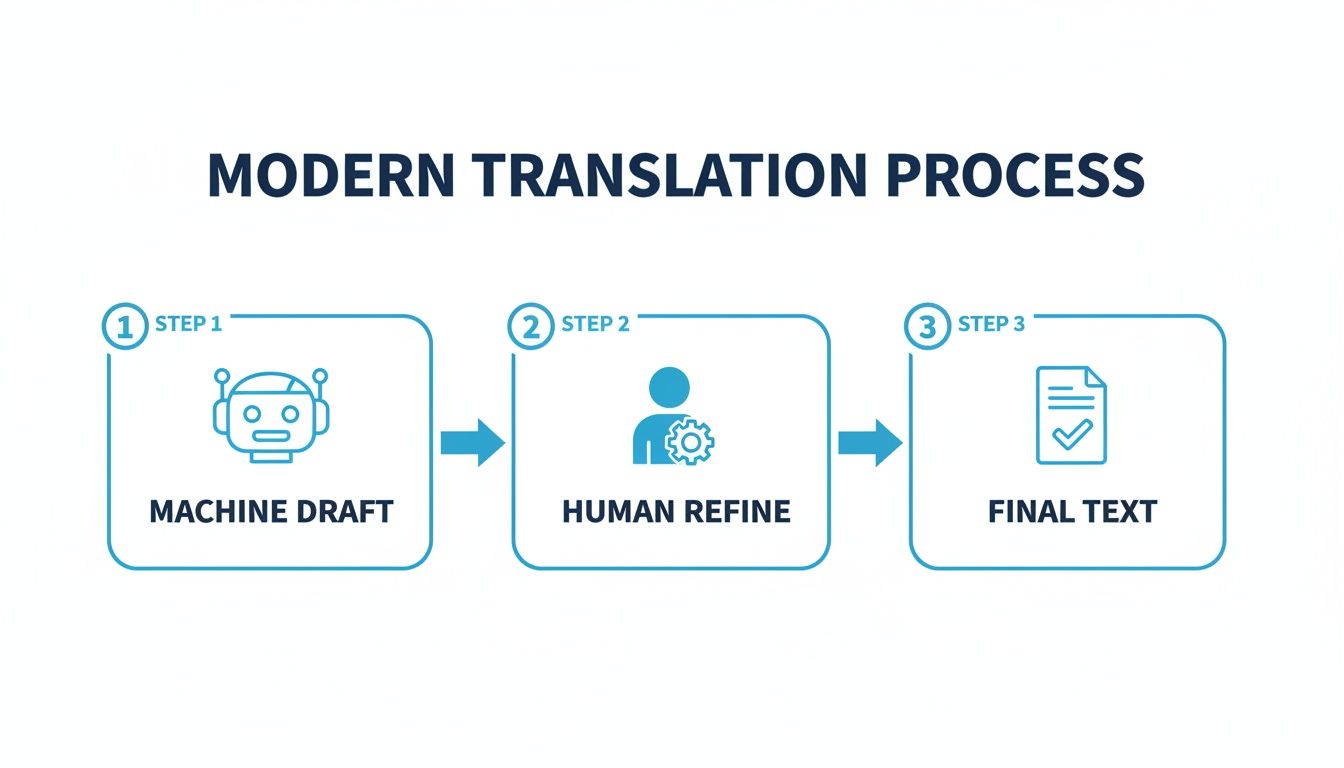
As you can see, the machine output is step one, not the final destination. The refinement phase is where the real value is added.
Your Post-Editing Checklist
To get a high-quality translation english to albania, a human editor needs to be methodical. Think of this as your quality control checklist for turning raw machine output into something great.
- Grammar and Syntax: Does it sound like natural Albanian? Machines often produce grammatically correct sentences that are just plain awkward.
- Cultural Nuances: Are there any jokes, references, or common sayings that just don't land in Albanian culture? These need to be adapted or swapped out entirely.
- Tone and Style: Does the text feel right for its purpose? Whether it's formal, casual, technical, or for marketing, a human editor must adjust the voice to match.
- Consistency Check: Are the key terms from your glossary used correctly and consistently from beginning to end?
Your best quality check is a native Albanian speaker. They will catch the subtle errors in phrasing, gender agreement, and idiomatic expressions that even a skilled non-native editor might overlook. Their feedback is what makes the content feel truly genuine, not just translated.
Spotting Common Machine Errors
Machine translation tools tend to stumble over the same hurdles in Albanian again and again. Knowing what these common pitfalls are helps an editor spot and fix them fast.
Language complexities like noun genders and verb conjugations, as highlighted above, are where automatic tools frequently trip up.
One of the biggest culprits is gendered nouns. In Albanian, adjectives and articles have to agree with the gender of the noun they modify. MT systems get this wrong constantly, resulting in sentences that just sound off to a native speaker.
Clumsy phrasing is another dead giveaway. The translation might be technically correct, but no native speaker would ever say it that way. An editor's job is to rephrase these awkward sections so they flow naturally. If you want to dig deeper into this refinement process, check out our guide on how to edit AI-generated content for a human touch.
Avoiding Common Pitfalls In English To Albanian Translation
Even with the best tools and a solid workflow, some mistakes just keep popping up in English to Albanian translation projects. Knowing what to look for ahead of time can save you from a world of awkward phrasing, confusing messages, and hours of extra editing.
Let's be honest, sidestepping these common errors is what separates a decent translation from one that feels truly native and professional.
One of the biggest traps is trying to translate English idioms and sayings literally. A classic like "it's raining cats and dogs" just doesn't work when you translate it word-for-word into Albanian. The meaning gets completely lost because the cultural reference simply isn't there. Your best bet is to always replace these expressions with their intended meaning for a message that's actually clear.
Another frequent slip-up is forgetting to localize units of measurement, dates, and currency. An Albanian reader expects to see prices in Lek (ALL), distances in kilometers, and dates written in a Day/Month/Year format. Overlooking these small but crucial details can make your content feel foreign and even a little untrustworthy.
Getting The Tone Right: Ti vs. Ju
In Albanian, your choice between the informal "ti" (you) and the formal "ju" (you) is a huge deal. It’s similar to the "tú" versus "usted" distinction you see in Spanish, and it sets the entire tone by reflecting the level of respect and familiarity you have with your audience.
Get it wrong, and you can come across as either disrespectful or awkwardly distant.
A machine translation will often just default to one form—usually the formal "ju"—without understanding the context at all. A human editor's job is to make the call: is this for a casual blog post targeting young people, or is it a formal business proposal? This single choice has a massive impact on the final tone.
The Critical Role Of Context
Beyond specific words, context is absolutely everything. A single English word can have a dozen different meanings, and without understanding the surrounding text, a machine is just taking a wild guess. Take the word "run"—it could mean physically moving, operating a machine, or managing a business. Each of these requires a totally different Albanian verb.
This lack of contextual awareness is why a machine might spit out a sentence that’s grammatically perfect but makes zero sense. A human reviewer is essential for catching these blunders and making sure the translation truly captures the original intent. This careful review process is what separates a mediocre translation english to albania from one that genuinely connects with readers.
Common Translation Errors and How to Fix Them
To give you a better idea, here are a few real-world examples that show just how wrong a literal translation can go. These are the kinds of mistakes that immediately signal a low-quality translation.
| English Phrase | Common Mistake | Correct Albanian Translation |
|---|---|---|
| "Break a leg!" | "Thyej një këmbë!" | "Suksese!" or "Paç fat!" (Good luck!) |
| "Once in a blue moon" | "Një herë në një hënë blu" | "Shumë rrallë" (Very rarely) |
| A formal email | Using "ti" throughout | Using "ju" for respect |
As you can see, a direct, word-for-word approach often fails to capture the real meaning. Careful post-editing is what confirms your message is not only understood but also culturally on-point.
Common Questions About Translating To Albanian
Even with a solid workflow in place, you probably have a few questions floating around about the details of translating English to Albanian. Let's tackle some of the most common ones I hear from clients to get you the straight answers you need.
How Much Does Albanian Translation Cost?
This is the big one, and the honest answer is: it varies. The final price tag usually comes down to a few key things, and it’s almost always priced per word.
- Content Complexity: A simple blog post is one thing, but technical manuals, legal documents, or medical content? That requires a specialist with deep subject matter knowledge, and the rate will reflect that expertise.
- Turnaround Time: Need it yesterday? Rush jobs will almost always cost more. If you can build a standard turnaround time into your schedule, you'll find it's much friendlier on the budget.
- Project Size: Good news for big projects. Many translators and agencies offer volume discounts. This means translating a 10,000-word user guide might actually have a lower per-word cost than a quick 500-word article.
As a general ballpark, you can expect to pay anywhere from $0.08 to $0.25 per word for a professional human translator. If you're using a more modern workflow that blends machine translation with a final human polish, those costs can often be quite a bit lower.
What Is a Typical Project Timeline?
Time is money, right? A skilled professional translator can realistically handle about 2,000 to 2,500 words per day. That number isn't just raw translation, either—it includes the crucial time needed for proofreading and quality checks.
So, if you have a 5,000-word document, a realistic timeline is about two to three business days. But here’s a pro tip: always buffer your timeline. Factor in a little extra time for project setup, back-and-forth communication, and any final reviews on your end. Trying to rush it is the fastest way to let mistakes slip through.
What Is The Difference Between Standard and Certified Translation?
This is a really important distinction, and getting it wrong can cause major headaches, especially with official paperwork.
- Standard Translation: Think websites, marketing brochures, and internal company emails. The goal here is communication that’s clear, natural, and speaks to the target audience.
- Certified Translation: This is the heavyweight. It’s required for official documents like birth certificates, university transcripts, legal contracts, or immigration forms. The translator or their agency must provide a signed statement—a "Certificate of Accuracy"—vouching for the translation's completeness and correctness.
A certified translation is essentially a legal record. It’s not about creative flair; it’s about a literal, faithful rendering of the original document for official bodies like courts, government agencies, or universities. Not just any translator can do this, so make sure you specify upfront if you need a certified translation.
It's a common myth that a higher price tag automatically means better quality. The best value actually comes from a process that’s suited to your specific needs. For something like a company blog, a modern workflow combining a tool like Word Spinner for a natural rewrite with a final human review is often the perfect blend of quality, speed, and cost-effectiveness.
And if you're curious about the tech behind these modern workflows, you might find our article on if DeepL translation can be detected interesting. It gives you a peek behind the curtain at the tools shaping the industry.
Ready to create content that sounds truly human and connects with any audience? Word Spinner offers advanced rewriting capabilities to polish your translations, remove AI detection, and ensure your message is 100% original and natural. Try Word Spinner for free and see the difference.