Your Guide to the Best Undetectable AI Writer App

An undetectable AI writer app is much more than a simple rephrasing tool. Think of it as specialized software designed to rewrite machine-written text until it sounds completely natural—as if a person wrote every word. This lets creators produce content quickly without the robotic, predictable patterns that AI checkers are built to spot.
The Growing Need for Human-Sounding AI Content

Content creation has been turned on its head. What used to take hours of deep focus can now be put together in just a few minutes. This massive shift is fueling a booming industry; the market for AI writing assistants is already worth billions and is expected to hit nearly $80.12 billion by 2030. While this explosion means the tools are constantly improving, it also means the internet is getting flooded with generic, machine-like text.
This flood of AI-produced writing has created a brand-new problem. Readers, search engines, and universities are getting much better at sniffing out content that lacks a human touch. Robotic, stiff text just doesn't connect with people, can damage a website's credibility, and might even get flagged for academic dishonesty.
Why Authenticity Matters More Than Ever
The biggest issue with standard AI outputs is that they feel sterile and impersonal. The grammar might be perfect, but they’re missing the unique voice, rhythm, and quirks of human expression. This is where "humanizing" comes in—it’s the art of taking that bland text and injecting it with personality.
The goal isn't just to produce content faster anymore. It's about making content that builds trust, actually interests readers, and sounds like it came from a real person or brand.
This drive for authenticity impacts almost everyone making content today:
- Marketers need to keep a consistent, relatable brand voice that connects with their audience.
- Students want to make sure their work meets academic standards without being falsely flagged by checkers.
- Writers use it to smash through writer's block and polish drafts without losing their personal style.
As the demand for high-quality, human-sounding text skyrockets, many are looking for the best AI writing software tools that can help. These apps do more than just swap out a few words; they fundamentally restructure sentences to make them feel genuine. To get a better handle on this, you might want to check out our guide on why humanizing AI content is essential for engagement. It breaks down how human-like writing leads directly to better results and stronger connections with your readers.
How AI Checkers Spot Machine-Written Text
To beat the AI checkers, you first have to get inside their heads. Think of these tools as digital bloodhounds, sniffing out specific clues that scream "a robot wrote this!" They don't read for meaning or appreciate your clever arguments; they just hunt for patterns.
The two biggest giveaways they're trained to find are perplexity and burstiness. It sounds complicated, but the idea is simple. Perplexity is just a fancy word for unpredictability. Real human writing is a little wild and messy. We use odd phrases, surprising word choices, and sentences that don't always follow a perfect formula. AI text, on the other hand, usually plays it safe with common words and predictable sentence structures.
The Telltale Signs of AI Writing
Burstiness is all about rhythm. When people write, we create a natural cadence. A long, winding sentence might be followed by a short, sharp one. This creates variety and keeps things interesting. AI models often struggle with this, churning out sentences that are all roughly the same length and structure, which sounds flat and monotonous to a checker.
These checking tools are shown mountains of human writing to learn what feels "normal." When they scan your content, they’re looking for anything that strays from that human baseline. Here’s what sets off their alarm bells:
- Uniform Sentence Structure: If every sentence follows the same boring subject-verb-object pattern, it’s a massive red flag.
- No Personality: We humans use idioms, inside jokes, and personal stories. AI-written text is often sterile and completely lacks that human touch.
- Perfect but Lifeless Grammar: An AI can write with flawless grammar, but it often misses the stylistic flair and intentional imperfections that make writing feel authentic.
The Achilles' heel for most AI models is their love of the average. They produce text that is statistically likely but lacks the creative spark and deliberate imperfection that define human writing.
To really fly under the radar, you need to understand the complex AI content analysis techniques these checkers use to catch machine-written content.
This graph makes it plain that while different checkers have different success rates, they’re all built on the same core idea of pattern finding. That variability is also why they're far from perfect.
The Problem with False Positives
It's important to remember that these tools are not infallible. One of their biggest flaws is the false positive—when they flag 100% human-written text as being made by a machine. This often happens with writing that's very formal, direct, or has to follow a strict structure.
For a deeper look into how they work, you can read our guide on what an AI detector looks for. Knowing their weaknesses is the first step in learning how to craft your text to avoid getting unfairly flagged.
Core Qualities of a Top-Tier AI Humanizer
Not all tools that claim to make undetectable AI content are created equal. Many basic paraphrasing apps just swap out a few words for synonyms, which often leads to awkward, clunky sentences that AI checkers can spot a mile away. A truly effective undetectable AI writer app, on the other hand, operates more like a seasoned human editor than a simple thesaurus.
The biggest difference is the ability to perform advanced rewriting. This isn't just about finding a different word; it's about completely reimagining the sentence. A good tool will alter sentence structures, merge short phrases into more complex thoughts, or break down long, rambling sentences into punchier statements. This is exactly what creates the natural variety found in human writing.
Moving Beyond Simple Word Swapping
Another critical aspect is the power to adjust tone and voice. A premium tool will let you define the exact personality you're going for—whether you need your content to be professional, casual, witty, or academic. This level of control is essential for maintaining a consistent brand voice or matching your personal writing style, making the final text feel genuinely yours.
An exceptional humanizer doesn't just make text sound less like a machine; it makes it sound more like you. That's the key distinction between a passable tool and an indispensable one.
Finally, the best platforms always include a built-in checking system. This lets you instantly verify your content's authenticity right after you humanize it, giving you peace of mind before you publish. Without this, you’re just crossing your fingers and hoping the text will pass, which completely defeats the purpose.
To give you a better idea of what these checkers are looking for, the image below breaks down the common patterns they're trained to find in machine-written text.
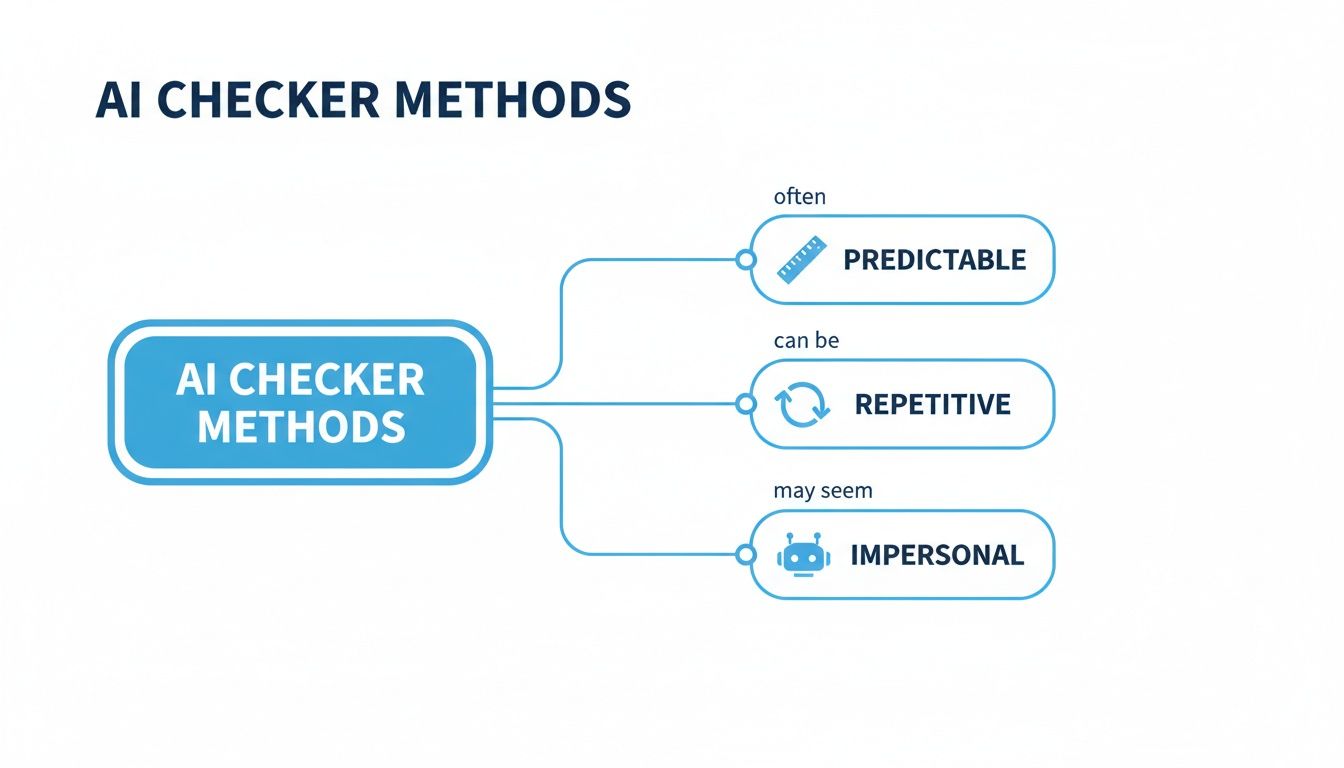
As you can see, AI writing often falls into predictable, repetitive, and impersonal traps. These are the red flags that trigger checking software. When you're evaluating any undetectable AI writer app, make sure it has the means to overcome these exact weaknesses.
Essential Things to Look For to Bypass AI Checkers
Choosing the right tool can feel overwhelming, but a few core things separate the best from the rest. The table below outlines what you should look for to ensure you're getting a tool that can consistently produce natural, human-like content.
| Aspect | Why It Matters | What to Look For |
|---|---|---|
| Contextual Rewriting | Preserves the original meaning and nuance of your text instead of just swapping words. | The ability to restructure sentences, vary sentence length, and maintain the core message. |
| Tone and Voice Control | Allows you to match a specific brand identity or personal style, making the content authentically "you." | Customization options for different tones (e.g., professional, casual, academic) and writing styles. |
| Integrated AI Checker | Provides immediate feedback on whether your content will pass, saving time and eliminating guesswork. | A built-in part that scans the text for AI patterns and gives you a "human score" or pass/fail result. |
| Plagiarism-Free Output | Ensures your rewritten content is 100% original and won't get you flagged for duplicate content issues. | A clear guarantee of originality and a built-in plagiarism checker for added security. |
| Easy-to-Use Interface | Makes the job of humanizing content quick and simple, without requiring a steep learning curve. | A clean, simple layout where you can paste text, select options, and get results in a few clicks. |
By prioritizing these items, you can confidently select a tool that does more than just disguise AI text—it helps you make genuinely compelling content that connects with readers.
For a deeper dive into the top options on the market, take a look at our roundup of the best AI humanizer tools available today. Knowing what to look for will help you pick an app that truly delivers on its promise of natural-sounding text.
Practical Steps to Humanize Your AI Content
Knowing what makes AI checkers tick is one thing, but actually tweaking your content to fly under their radar is a whole different ballgame. The good news? You don't need to be a seasoned editor to breathe life into your text. A few key adjustments can turn robotic paragraphs into something that genuinely connects with readers.
The easiest place to start is by varying your sentence length and structure. AI models love falling into a comfortable, predictable rhythm, churning out sentences that are all roughly the same length. You can shatter that pattern by mixing short, punchy sentences with longer, more detailed ones. It’s a simple shift that makes the writing feel less like a machine and more like a conversation.
From Robotic to Relatable
Another great trick is to inject a bit of your own voice and personal stories. Maybe you share a quick, relevant anecdote, use a common idiom, or pop in a rhetorical question to get your reader thinking. These touches add a layer of authenticity that AI, on its own, just can't manufacture.
Don't forget to simplify your language. AI has a habit of using overly formal or complex words when a simple one would work just fine. Swapping out jargon for plain English makes your content more accessible and conversational.
Here’s a quick before-and-after to show you what I mean:
Before (Classic AI Speak):
"The implementation of a new marketing strategy is imperative for business growth. This process requires a comprehensive analysis of market trends and consumer behavior to ensure optimal performance and engagement across multiple platforms."
After (Humanized Version):
"If you want your business to grow, you have to nail your marketing strategy. It all starts with understanding what your customers actually want and where they're spending their time. Get that right, and you'll see your engagement climb."
See the difference? The "after" version is direct, clear, and sounds like something a real person would actually say. It ditches the stuffy corporate tone for one that’s instantly more relatable. While you can definitely make these edits by hand, it can be a real time-sink, especially for longer articles. That’s where an undetectable AI writer app comes in clutch.
Speeding Up the Humanization Process
Tools built for this exact purpose can automate these changes in seconds. A great humanizer like Word Spinner does more than just swap a few words around. Its advanced rewriting capabilities completely rework sentence structures, adjust the tone, and mix up word choices to perfectly mimic human writing patterns. This helps you get genuine, 100% plagiarism-free output that bypasses ai detection without the manual effort.
These manual tips are a great starting point for making quick fixes. But if you want to dive deeper, check out our guide on how to humanize AI content for more advanced ideas. Combining these approaches will help you make content that not only connects with your audience but also sails right past any AI checker.
The Content Arms Race in Education and Business
The explosion of AI writing assistants has officially kicked off a cat-and-mouse game between content creation and checking. As these tools got better, schools and businesses scrambled to put checking policies in place, creating a high-stakes environment for students and professionals.
This isn't just some niche tech issue—it's a full-blown arms race. A staggering $33.9 billion in private investment flooded this space, pushing writing assistants into everyday use in classrooms and offices everywhere. In response, academic institutions and publishers rolled out AI checkers, which, in turn, fueled the demand for tools that could make AI text sound genuinely human. You can read the full report from Stanford's AI Index to see just how this investment cycle has played out.
Navigating a New Landscape
This constant back-and-forth has left a lot of people caught in the crossfire. Students are worried about getting flagged by a false positive on a paper they actually wrote, while professionals fear their work might be unfairly dismissed as machine-written. These are completely valid concerns, especially since many commercial checkers have proven inconsistent, sometimes flagging perfectly human writing.
This entire situation shines a spotlight on the real-world need for a reliable, undetectable AI writer. These tools aren't just about bypassing rules; they've become essential for navigating a new and often confusing technological world. They give you a way to smooth out the rough edges of an AI draft, making sure the final piece truly reflects your own knowledge and style.
In this new environment, the goal is to use AI as a collaborator, not a crutch. A good humanizer helps bridge that gap, turning a sterile draft into a polished piece of work that is authentically yours.
This ongoing tug-of-war only reinforces the need for tools that can polish and humanize text. For anyone making content today, having a way to ensure your writing sounds natural and avoids an unfair flag is no longer a luxury—it’s a necessity.
Common Questions Answered
Got questions about making your AI content sound more human? Let's clear up a few common points.
Is It Wrong to Use an Undetectable AI Writer App?
Honestly, the ethics come down to your intent. Are you using it to smash through writer's block, find a clearer way to phrase a tricky sentence, or just explore different angles for an idea? That’s perfectly fine. It's a tool to help you think.
Where it gets shady is when the goal is to deceive someone, plagiarize an academic paper, or knowingly violate rules set by your school or company. The whole point should be to improve your own creativity and knowledge, not to cut corners and pass off someone else's work (even a machine's) as your own.
Can AI Content Ever Be Completely Undetectable?
While the best tools can make AI text incredibly hard to spot, no app can give you a 100% guarantee against every single AI checker, especially as the tech on both sides keeps evolving. It’s a constant cat-and-mouse game.
Your best bet is to let a powerful humanizer like Word Spinner do the heavy lifting to get you 99% of the way there. It excels at humanizing content for a natural tone and is designed to remove ai detection. Then, always give it a final once-over yourself. Adding a personal story, a unique opinion, or fixing a slightly odd phrase is the final touch that makes all the difference.
Aren't These Just Fancy Paraphrasing Tools?
Not at all. A standard paraphrasing tool just plays a game of word swap, replacing words with synonyms. This usually leaves you with clunky, unnatural sentences that modern AI checkers can sniff out in a second.
An undetectable AI writer app is in a completely different league. It uses complex methods to tear down and rebuild the content from the ground up—restructuring sentences, shifting the tone, and using varied vocabulary to mimic the natural rhythm of human writing. The difference is night and day; the result is text that actually flows and connects with a reader.
Ready to create authentic, human-sounding content that actually connects with your audience? Try Word Spinner today and see what a real AI humanizer can do. Get started for free at https://word-spinner.com.