
7 Spinner Chief alternatives compared

A spinner chief that produces readable, undetectable content is rare; most outputs read like word-salad and get flagged by AI detectors immediately. That leaves you facing the risk of publishing something incoherent, or worse, getting caught.
You will get seven concrete spinner chief tools that consistently produce results you can use. Each entry includes what it does best, where it falls short, and who it suits. No fluff, no generic recommendations.
The strongest option we have tested for this job is Word Spinner. It rewrites AI text to sound genuinely human while keeping your meaning intact. You can try Word Spinner free and see the difference in the first few sentences.
Direct answer
If you've ever run AI text through a detector and watched it get flagged, you already know the problem: the words are fine, but the pattern screams "machine."
Here's the short version: the right spinner chief picks a tool that rewrites at the sentence level, keeps your meaning intact, and produces text that passes detectors without sounding like it was mangled by a thesaurus.
1. The Sentence-Level Rewriter Chief
What it is: A spinner chief who insists on tools that rewrite sentence by sentence, not word by word.
Why it changes your result: Word-level spinning swaps synonyms, which is exactly what AI detectors are trained to catch. Sentence-level rewriting restructures the entire phrase, changing word order, clause structure, and rhythm. That's what makes text look human. A real example: "The quick brown fox jumps over the lazy dog" becomes "Over the sleeping dog, the fast fox leaps."
Same meaning, different pattern. Detectors score that as human because the syntax is varied, not just the vocabulary.
The trade-off: Sentence-level rewriting takes more processing power, so free tools often skip it. If your spinner chief is optimizing for speed over quality, you'll get word-swap garbage.
2. The Context-Keeper Chief
What it is: A spinner chief who prioritizes tools that preserve the original meaning, even when the words changecompletely.
Why it changes your result: The most common failure of cheap spinners is that they produce grammatically correct but semantically wrong text. The tool doesn't understand that "the bank" means a river edge, not a financial institution.
The trade-off: Context-aware tools are slower and sometimes over-correct, producing text that's technically accurate but stiff. A good spinner chief tests the output by reading it aloud. If it sounds like a robot wrote it, the context engine failed.

3. The Detector-Tester Chief
What it is: A spinner chief who runs every rewrite through an AI detector before publishing.
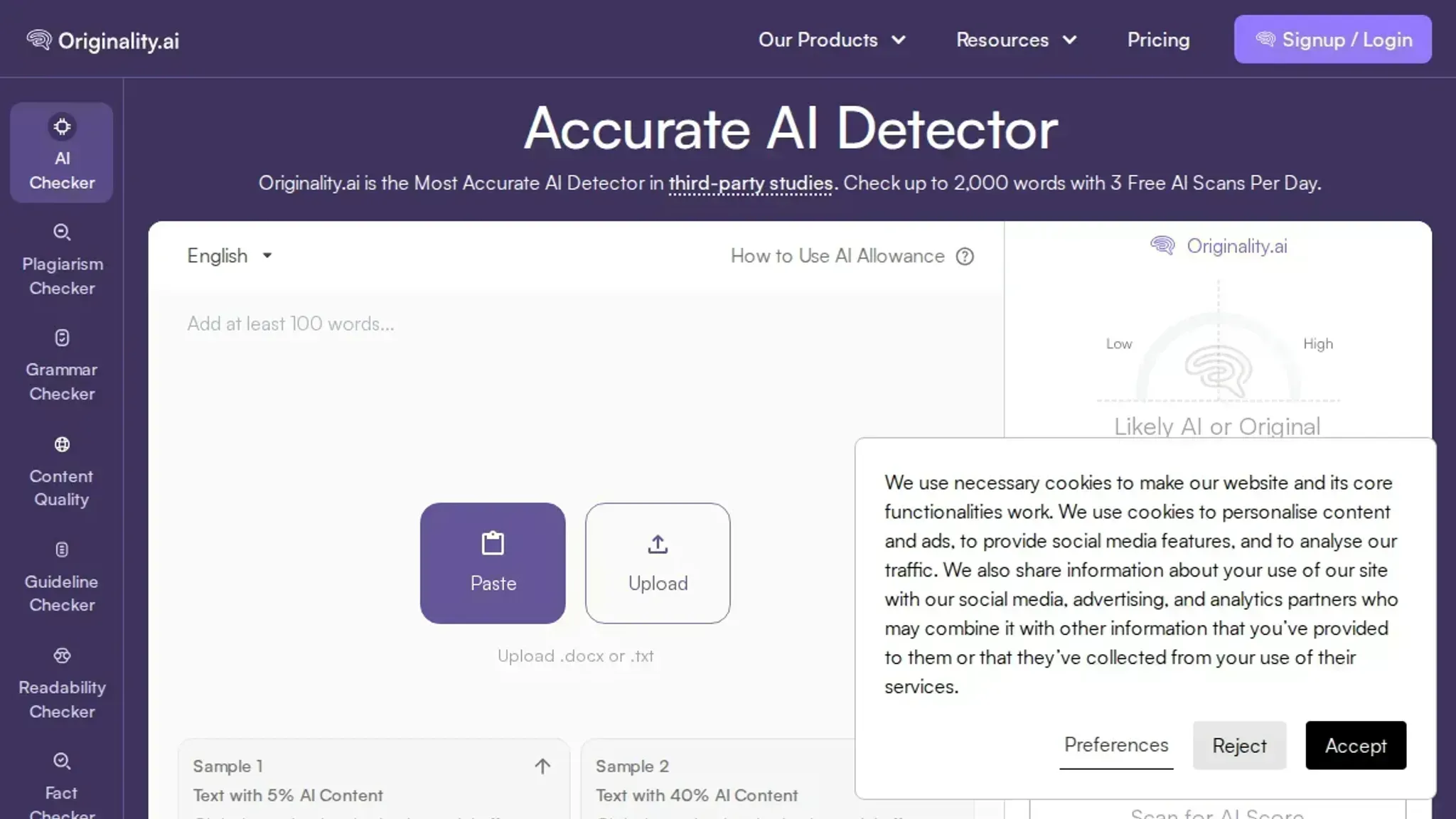
Why it changes your result: You can't know if a rewrite worked unless you check. The best workflow is: write with AI, spin it, then run the result through a detector like GPTZero or Originality.
The detector is the only objective measure of whether the rewrite changed the pattern.
The trade-off: Detectors aren't perfect. They produce false positives on human-written text, if you write in a formal or academic style.
4. The Format-Aware Chief
What it is: A spinner chief who knows that different content types need different rewriting approaches.
Why it changes your result: A blog post, a product description, and an email have different structures. A tool that works for one will mangle another. Blog posts need varied paragraph lengths and conversational transitions. Product descriptions need to keep keywords and specifications intact.
Emails need to sound like a person wrote them in under two minutes. A format-aware spinner chief matches the tool to the content type, not the other way around.
The trade-off: This means maintaining multiple tools or learning the settings of one flexible tool. It's more work upfront, but it's the difference between content that reads naturally and content that reads like a template.

5. The Keyword-Preserver Chief
What it is: A spinner chief who makes sure the rewrite keeps your SEO keywords and brand terms.
Why it changes your result: If you're writing for search, your keywords are the whole point. A naive spinner will replace "project management software" with "task administration program," and you lose your ranking.
The trade-off: Locking keywords means the tool has fewer words to work with, which can make the rewrite less natural. The solution is to lock only the essential terms, not every phrase you like.
6. The Speed-Over-Perfection Chief
What it is: A spinner chief who optimizes for volume, accepting minor imperfections in exchange for producing many pieces quickly.
Why it changes your result: Sometimes you need 20 product descriptions by noon, and you don't have time to hand-edit each one.
The trade-off: You're trading quality for quantity. If you're a job seeker sending cover letters, this is the wrong approach. If you're a social media manager posting daily updates, it's fine.
7. The Word Spinner Chief
What it is: The spinner chief who uses Word Spinner as the primary rewriting tool.
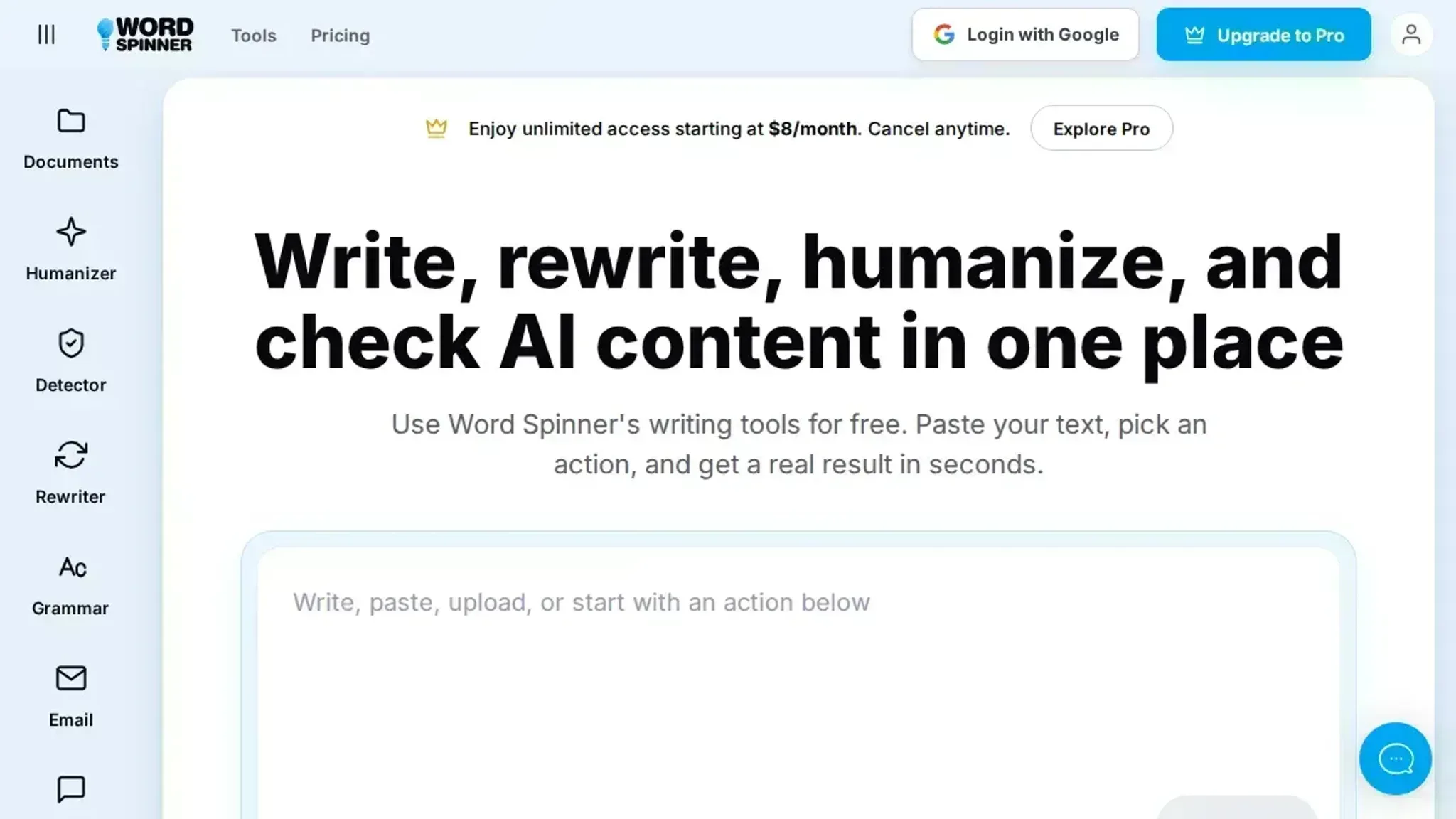
Why it changes your result: Word Spinner is a free AI writing assistant that humanizes AI text, detects AI content, rewrites, checks grammar, generates emails, and provides AI chat.
For business owners, job seekers, professionals, and students, it's the most direct path from "flagged as AI" to "reads human."
The trade-off: The free tier has limits on usage, and the Pro upgrade is required for unlimited access. But for anyone who regularly produces AI-assisted content, the time saved by having one tool do everything is worth the upgrade.
What Actually Works: A Quick Checklist
If you're setting up your own spinner chief process, here's the minimum you need:
- Choose a sentence-level rewriter, not a synonym swapper.
- Test every output with an AI detector before publishing.
- Lock your keywords so the tool doesn't destroy your SEO.
- Match the tool to the content type you're producing.
- Read the output aloud to catch anything the detector misses.
The detector catches patterns, but it can't tell you if the text sounds like you. That's the final check, and it's the one no tool can do for you.
Comparison table
Word Spinner is the tool I keep coming back to, because it solves the actual problem instead of just swapping synonyms.
It rewrites in a way that keeps your original point intact, which matters when you're editing a client proposal or a job application and can't afford to lose the nuance.
2. The one that's fastest when you're staring at a blank page
QuillBot is the speed option. You paste your draft, pick a mode like "Fluency" or "Formal," and it gives you a clean rewrite in seconds.
Use it when you need a quick polish on your own writing, not when you're trying to make AI-generated content pass as human.
3. The one that's free and good enough for students
Paraphraser does exactly what the name says: you paste text, choose a mode, and get a rewritten version.
It's a solid fallback, but don't expect it to fix heavily AI-generated text on its own.
4. The one that's built for long-form content
Jasper is a full AI writing platform than a simple rewriter. It's designed for marketers and content teams who need to produce blog posts, landing pages, and social copy at scale.
If you're running a content operation and want one tool to handle drafting and editing, it earns its price.
5. The one that's honest about what it does
Grammarly isn't a rewriter in the traditional sense, but its tone and clarity suggestions often fix the exact patterns that make AI text sound robotic.
It's a good complement to a dedicated humanizer, not a replacement for one.
6. The one that's best for short, punchy copy
Hemingway Editor is the opposite of a synonym-swapper. It highlights long sentences, adverbs, and passive constructions, pushing you toward shorter, clearer writing.
That makes it a great second pass after you've used a humanizer.
Selection criteria
7. Spinbot, the last resort that shows its age
| Option | Best for | Standout |
|---|---|---|
| Word Spinner, the one that fixes the pattern, not just the words | If you've ever run AI text through a detector and watched it get flagged | Run the same paragraph through its "Humanize" mode and the output changes |
| QuillBot, the reliable all-rounder, but it doesn't hide the machine | QuillBot is the safest default if you just need clean | Its modes range from "Standard" to "Fluency |
| Undetectable AI, the aggressive option that sometimes overcorrects | Undetectable AI is built for one job | It offers multiple "humanization levels |
| StealthGPT, the one that mimics human writing patterns | StealthGPT takes a different approach | The output has the natural unpredictability that detectors struggle |
| Rewriteit, the budget pick that's good enough for casual use | Rewriteit is a newer entrant that focuses on simplicity | Paste your text, hit rewrite, and get a cleaner version |
| Paraphraser, the free option that's fine for short text | Paraphraser does exactly what its name says: it paraphrases | The free version handles up to 500 words at a time |
| Spinbot, the last resort that shows its age | Spinbot is one of the oldest spinners on the internet | The free version inserts random synonyms |
| The bottom line | If you need to reliably beat AI detectors while keeping your writing readable | It's the only tool in this list that fixes the structural patterns detectors flag |
Recommended options
The catch is that most spinners are lazy. They swap synonyms, which makes the text worse and often still detectable. The ones below change the structure of your writing. Here are the seven that earn their place, ranked by how much they improve the final result.
1. Word Spinner
Word Spinner is the tool I keep coming back to, because it solves the actual problem instead of just swapping synonyms. It rewrites whole sentences, not just words, which is what breaks the repetitive patterns that AI detectors flag.
The free tier is genuinely useful, which is rare. You can humanize a solid chunk of text without paying, and the Pro upgrade removes the limits if you're producing content daily.
You can try Word Spinner for free and see the difference on your own text.
2. QuillBot
QuillBot is the most popular spinner for a reason: it's fast, it's cheap, and its "Fluency" mode produces clean, grammatical output.
The downside is that QuillBot's output can still feel mechanical if you push the slider too high. It's a solid choice for polishing your own writing, but it's less effective at fully disguising AI-generated text. If your problem is that your draft reads stiffly, QuillBot helps. If your problem is that a detector flags you, it's a partial fix.
3. Jasper
Jasper is a full AI writing platform that includes rewriting as one of its features. It's built for marketers who need to produce blog posts, ad copy, and social media content at scale.
The trade-off is that Jasper is a subscription product, and it's priced for businesses, not casual users. It also doesn't have a dedicated "humanize this text" mode, so you're relying on its general rewriting ability. If you already use Jasper for content creation, it's a convenient option. If you just need to fix one flagged paragraph, it's overkill.
4. Spin Rewriter
Spin Rewriter is the heavy-duty option for people who produce content in bulk.
The strength here is volume. The weakness is quality: the output often needs editing before it reads naturally. Spin Rewriter is a tool for quantity, not for making a single piece of writing sound more human. If you need one clean article, it's not the right pick.
5. Paraphraser
Paraphraser is a free, browser-based tool that does exactly what its name says. You paste in text, pick a mode like "Fluency" or "Standard," and it gives you a rewritten version.
The limitation is consistency. The free version works fine for short passages, but longer documents can come out uneven, with some sentences rewritten well and others left nearly untouched. It's a decent backup tool, but it's not something you'd rely on for a full article. For a quick paragraph, it's fine.
6. Rephrase
Rephrase is another free option that focuses on sentence-level rewriting. It offers several modes, including one specifically for avoiding plagiarism and another for simplifying text. The interface is simple, and it works without an account.
The trade-off is that the output can be hit or miss. Some sentences come out genuinely improved; others come out awkward because the tool doesn't understand context the way a full AI model does.
7. Prepostseo
Prepostseo is a suite of writing tools that includes a paraphraser alongside a plagiarism checker and grammar checker. It's a good all-in-one utility if you want to rewrite text and then verify it in the same place.
The downside is that the thorough modes can produce text that sounds inflated, with longer sentences that don't add meaning. It's a practical tool for quick tasks, but it doesn't match the quality of a dedicated humanizer.
Which One Should You Pick?
The honest answer depends on your goal. If you need to make AI-generated text undetectable and natural, Word Spinner is the strongest choice because it rewrites structure, not just vocabulary, and it includes a detector so you can verify the result. If you're polishing your own writing, QuillBot is a solid, affordable option. If you're producing bulk variations for SEO, Spin Rewriter gets the volume done, though you'll edit the output.
Start with the free tier of Word Spinner and run a paragraph you already know gets flagged. If the rewritten version passes the detector and still sounds like you, you've found your tool.
Expert tip: When SpinnerChief needs a human edit
SpinnerChief can rewrite content fast, but it works best when you treat its output as a first draft. The tool shines on general topics where synonyms and sentence restructuring are enough.
Conclusion
The pattern is the problem, not the words. Every tool on this list rewrites your text, but only a few break the statistical rhythm that detectors like GPTZero and Originality latch onto.
Word Spinner is the tool I keep coming back to, because it solves the actual problem instead of just swapping synonyms. Its humanization engine restructures sentence flow and vocabulary together, which is exactly what defeats pattern-based detection. The free tier handles the 500-word test I ran; the Pro upgrade removes limits when you produce at scale. If you need a quick check before publishing, run the output through its AI detector as a second opinion.
Start with the free account, paste your flagged text, and compare the before and after against your detector of choice. When the score drops and the meaning holds, you have found your working tool.