A Simple Guide on How to Cite Multiple Authors

Knowing how to cite multiple authors can feel tricky, but it's really just about knowing when to use the shorthand "et al." (which means "and others"). The catch? The rules are different for APA, MLA, and Chicago style. As a general rule of thumb, if your source has three or more authors, you'll typically list the first author's last name, add "et al.", and you're good to go—at least for your in-text citation.
Why Citing Multiple Authors Correctly Is So Important
It wasn't that long ago that citing a source with a handful of authors was the exception. Today, it’s the standard. Research has become a team sport, and you’re far more likely to be referencing the collective work of a group than a lone scholar. Getting this right is a cornerstone of your credibility, whether you're writing a dissertation, a business plan, or a blog post.
Proper attribution is the bedrock of academic and professional integrity. It's how you show respect for the work that came before and prove you've done your homework. When you correctly credit every contributor, you build a foundation of trust with your readers and make your own arguments stronger by showing they stand on the shoulders of collective expertise.
The Rise of Team-Based Research
Over the past 50 years, the average number of authors on a single academic paper has jumped. This isn't just a quirky trend; it means that knowing "how to cite multiple authors" is now a fundamental writing skill, not a niche problem. Studies have shown that co-authored articles get cited far more often, which tells us that the most influential work in many fields is coming from collaborative teams.
This is especially true in medicine, tech, and the social sciences. Statistically, the odds are high that the most important sources for your project will have a long list of authors.
Making Sense of the Rules
Each major citation style—APA, MLA, and Chicago—has its own specific threshold for when to switch from listing out names to using "et al." This can get confusing fast, but a quick visual guide can make it much clearer.
This infographic breaks it down into a simple decision tree to help you nail the format every time.
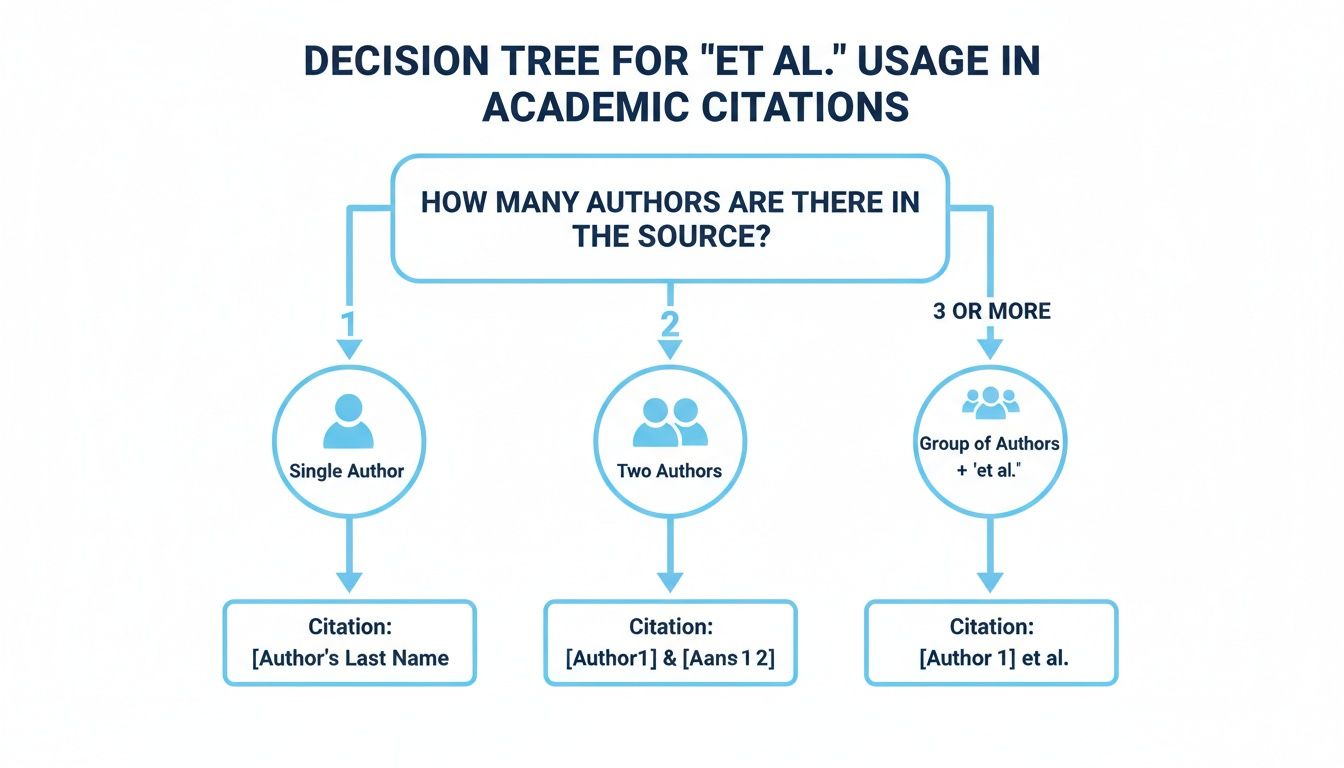
As you can see, the number of authors is the key variable. Once you know that, the rest is just following the formula for your chosen style.
Key Takeaway: Correctly citing multiple authors is more than just a fussy formatting rule—it’s about giving credit where credit is due and protecting your own credibility. Getting it wrong can look sloppy or, in academic circles, even raise red flags. For a deeper look into the importance of proper attribution, check out our guide on how to avoid plagiarism.
Of course, to cite sources correctly, you first have to identify all the authors and their contributions. Learning to read research papers efficiently is a foundational skill that makes the whole citation process smoother and much more reliable from the start.
Quick Guide to Using 'Et Al.' for Multiple Authors
To make things even easier, here's a quick-reference table summarizing the core rules for using "et al." across the big three citation styles. Keep this handy, and you'll save yourself a ton of time.
| Citation Style | In-Text Citation Rule | Reference List / Bibliography Rule |
|---|---|---|
| APA 7th Ed. | Use "et al." for 3 or more authors. (First Author's Last Name et al., Year). | List up to 20 authors. For 21+ authors, list the first 19, add an ellipsis (…), then list the final author. |
| MLA 9th Ed. | Use "et al." for 3 or more authors. (First Author's Last Name et al. Page Number). | For sources with 3 or more authors, list the first author followed by "et al." |
| Chicago 17th Ed. | For 4 or more authors, use "et al." (First Author's Last Name et al. Year, Page Number). | List up to 10 authors. For 11+ authors, list the first 7 followed by "et al." |
Think of this table as your cheat sheet. While each style has its quirks, seeing them side-by-side highlights the main differences you need to remember for in-text citations versus your final bibliography.
Citing Teams of Authors in APA Style

The American Psychological Association (APA) style is a go-to for anyone writing in the social sciences, business, or nursing, mainly because of its clear, author-focused system. When you're dealing with multiple authors, the 7th edition of APA has made things refreshingly simple, especially for in-text citations.
The biggest rule is a cinch to remember: if a source has three or more authors, you jump straight to using "et al." from the very first citation. This is a huge change from older editions that saves you a ton of space and helps your writing flow much more smoothly.
In-Text Citations The APA Way
Your main job with an in-text citation is to give your reader a quick signpost to the full reference at the end of your paper. APA offers two ways to do this: parenthetical and narrative.
A parenthetical citation tucks the author info neatly at the end of a sentence inside parentheses. In contrast, a narrative citation weaves the author's name right into your sentence, making them a part of the story you're telling.
Here's the breakdown for handling different author counts:
- Two Authors: You'll always name both authors every single time you cite their work. In parenthetical citations, you connect their names with an ampersand (&). For narrative citations, just use the word "and."
- Three or More Authors: From the very first mention, list only the first author's last name followed by "et al." for all citations.
Let's look at a few examples to see how this plays out.
Parenthetical Citation Examples
- Two Authors: Recent studies confirmed the initial hypothesis (Chen & Rodriguez, 2023).
- Three+ Authors: The framework was later expanded upon by other research teams (Miller et al., 2024).
Narrative Citation Examples
- Two Authors: Chen and Rodriguez (2023) confirmed the initial hypothesis in their recent study.
- Three+ Authors: According to Miller et al. (2024), the framework was later expanded upon.
Expert Tip: The details matter. Use an ampersand (&) inside parentheses but spell out "and" in your narrative text. Also, "et al." always gets a period after "al" because it's short for the Latin phrase et alia, which means "and others."
Formatting Your APA Reference List
The reference list is where you lay out all the details for every source you've mentioned. The rules here for multiple authors are a bit different and depend on just how many people contributed to the work.
Modern citation rules have had to adjust to the explosion of large-scale research collaborations. It's not uncommon now to see papers with dozens—sometimes hundreds—of authors. This shift forced style guides to change beyond simple two-author vs. three-author rules. Most guides now cap the number of names you list in a reference entry (often 6, 10, or 20) before switching to 'et al.'. Knowing these limits is crucial, especially when you're cleaning up citations from a generator that might list too few or too many names.
The APA 7th edition is quite generous with its author limit, which is a nod to those massive, collaborative projects.
- Two to 20 Authors: If your source has anywhere from two to 20 authors, you have to list every single one. Separate their names with commas, and make sure to put an ampersand (&) right before the final author's name.
- 21 or More Authors: For the big research teams with 21 or more authors, list the first 19 authors, then add an ellipsis (…), and finish with the very last author's name. Critically, you do not use an ampersand in this scenario.
APA Reference List Examples
Putting it all together, here are a few practical, copy-and-paste examples for different types of sources.
Journal Article (3 Authors)
Ahmed, S., Lee, Y., & Garcia, M. A. (2022). The impact of collaborative learning on student engagement. Journal of Educational Psychology, 114(3), 451–467. https://doi.org/10.1037/edu0000725
Book (2 Authors)
Kahneman, D., & Tversky, A. (2000). Choices, values, and frames. Cambridge University Press.
Website (Group Author)
World Health Organization. (2023, October 10). Mental health and COVID-19. https://www.who.int/teams/mental-health-and-substance-use/mental-health-and-covid-19
Keeping all these details straight, especially when footnotes or endnotes get involved, can be tricky. If you're navigating that, you might find our dedicated guide to APA format footnotes helpful, as it breaks the process down even more. Nailing these small but critical formatting rules is what will make your work look polished and professional every time.
Handling Multiple Contributors in MLA Style

If you're writing in the humanities—think literature, arts, or philosophy—you're almost certainly going to be using the Modern Language Association (MLA) style. The good news is that the 9th edition of the MLA Handbook keeps things pretty simple for citing multiple authors, making it one of the more straightforward systems out there.
One of the best things about MLA is that its rules for in-text citations and the final Works Cited page are very consistent. This makes it much easier to remember and apply the rules correctly across your entire paper. The core idea is simple: give credit clearly without cluttering your text.
MLA In-Text Citations: A Quick Overview
In MLA, an in-text citation’s main job is to point your reader to the full source on your Works Cited page. It's usually just the author's last name and the page number where you found the information, tucked neatly inside parentheses.
The format changes depending on how many authors collaborated on the source. For MLA, the magic number is three.
- Two Authors: When a work has two authors, you must list both last names every single time you cite them. Just connect their names with the word "and."
- Three or More Authors: If you’re pulling from a source with three or more authors, you only list the first author's last name, followed by the phrase "et al." This rule applies right from the very first citation.
Let's see what that looks like in a real paper.
Parenthetical Citation Examples
- Two Authors: The research highlighted a significant cultural shift during the period (Johnson and Bailey 45).
- Three+ Authors: Later interpretations challenged this view directly (Davies et al. 112).
Narrative Citation Examples
- Two Authors: As Johnson and Bailey argue, the cultural shift was significant (45).
- Three+ Authors: Davies et al. later challenged this view directly (112).
Key Reminder: "Et al." in MLA doesn't get a comma before it, and "al" is always followed by a period. It's an abbreviation for the Latin et alia, meaning "and others," so the period is non-negotiable.
Building Your MLA Works Cited Page
The Works Cited page is where you give the complete details for every source you've mentioned. Helpfully, the rules here mirror the logic of the in-text citations, which really simplifies things when you're managing a long list of sources.
Here's how the author count shapes your entry:
- Two Authors: List both authors in the order they appear on the title page. The first author is formatted as Last Name, First Name. The second is listed as First Name Last Name, with "and" connecting them.
- Three or More Authors: For sources with a bigger research team, you just list the first author (Last Name, First Name), followed by a comma and "et al."
This screenshot from the official MLA website shows the organization's focus on providing clear, accessible guidelines for writers.
The site is an essential resource, reinforcing why it’s so important to stick to established standards for academic writing.
Works Cited Examples
-
Book with Two Authors:
Gilbert, Sandra M., and Susan Gubar. The Madwoman in the Attic: The Woman Writer and the Nineteenth-Century Literary Imagination. Yale UP, 2000. -
Journal Article with Three or More Authors:
Ahmad, Aisha, et al. "Narrative Structures in Contemporary Fiction." Journal of Modern Literature, vol. 45, no. 2, 2022, pp. 78-94.
For a complete walkthrough, our guide on how to make a Works Cited page has even more examples and tips to make sure every detail is perfect.
Authors vs. Editors: A Common Mix-Up
One of the most frequent points of confusion is how to handle editors, especially for collections or anthologies where different people wrote different chapters. MLA has a clear and simple way to distinguish between them.
If you’re citing an entire book compiled by editors, their names go in the author's spot, followed by the label "editors."
- Example (Edited Book):
Holland, Merlin, and Rupert Hart-Davis, editors. The Complete Letters of Oscar Wilde. Henry Holt, 2000.
But if you’re only citing one chapter or essay from that collection, you start with the author of that specific piece. The book's editors show up later in the citation, right after the book's title.
- Example (Work in an Anthology):
Poe, Edgar Allan. "The Fall of the House of Usher." American Gothic Tales, edited by Joyce Carol Oates, Plume, 1996, pp. 58-75.
Getting this distinction right is crucial for guiding your reader to the exact source material. By following these clear MLA rules for multiple authors and editors, you ensure your work is credible, professional, and easy for others to follow.
A Practical Guide to Chicago Style Citations
Chicago style often gets a reputation for being complicated, but that’s really just a reflection of its incredible flexibility. You'll see it used all the time in history, the arts, and humanities because it offers writers two distinct systems: Notes and Bibliography and Author-Date. Which one you use really just depends on what your professor or publisher prefers.
Most people think of the Notes and Bibliography system when they hear "Chicago." This is the classic approach that uses footnotes or endnotes to cite sources, which keeps the body of your paper looking clean and uncluttered. The Author-Date system, on the other hand, will feel very familiar if you've ever used APA, with in-text parenthetical citations that are perfect for the social sciences.
The Notes and Bibliography System
This is Chicago at its most traditional. When you need to cite something, you pop a small superscript number in your text. That number then corresponds to a numbered note at the bottom of the page (a footnote) or at the very end of your document (an endnote).
The first time you cite a source, the note will contain all the publication details. For any subsequent mentions of that same source, you can use a much shorter note. Simple enough, right?
Where it gets tricky is that the rules for citing multiple authors are different for your notes versus your final bibliography.
- For Two or Three Authors: You'll list all the authors' names in both the note and the bibliography entry.
- For Four to Ten Authors: This is a key difference. In your note, you only list the first author's name followed by "et al." But in the bibliography, you have to write out all of the authors' names.
- For More Than Ten Authors: To save space, the bibliography entry will list the first seven authors, followed by "et al." The note format stays the same (just the first author plus "et al.").
As the official source, The Chicago Manual of Style is the definitive resource for editors and writers. It covers just about any citation scenario you can imagine, showing just how much precision matters.
Let's see this in action with some examples.
Footnote Examples
-
Two Authors:
- Scott Decker and Margaret Townsend, Drug Smugglers on Drug Smuggling: Lessons from the Inside (Philadelphia: Temple University Press, 2008), 25.
-
Four Authors (First Note):
- David Green et al., The New Deal and American Politics (New York: Oxford University Press, 2017), 114.
Shortened Note Example
If you cite those same sources again later in your paper, the notes get much tidier.
-
Two Authors (Shortened):
- Decker and Townsend, Drug Smugglers, 41.
-
Four Authors (Shortened):
- Green et al., New Deal, 120.
Bibliography Examples
Now, here’s how those sources would appear in the full bibliography at the end of your work. Notice the small but important differences in formatting and author listing.
-
Two Authors:
Decker, Scott, and Margaret Townsend. Drug Smugglers on Drug Smuggling: Lessons from the Inside. Philadelphia: Temple University Press, 2008. -
Four Authors (All Listed):
Green, David, Sarah Burns, Michael Clark, and Jessica Patel. The New Deal and American Politics. New York: Oxford University Press, 2017.
Crucial Difference: If you only remember one thing, make it this: the rules for notes and the bibliography are not identical. Notes start using "et al." for four or more authors, but the bibliography lists up to ten full names before switching to "et al."
The Author-Date System
If you're writing in the sciences or social sciences, you'll likely be pointed toward Chicago's Author-Date system. This format feels a lot more like APA, with parenthetical citations inserted directly into your sentences. These citations typically include the author's last name and the publication year.
The rules for multiple authors here are much more consistent and easier to remember.
For in-text citations:
- For Two or Three Authors: List the last names of all the authors.
- For Four or More Authors: Just list the first author's last name, followed by "et al."
Author-Date In-Text Examples
- Two Authors:
(Decker and Townsend 2008, 25) - Four Authors:
(Green et al. 2017, 114)
The reference list at the end of your paper for the Author-Date system looks almost identical to the bibliography in the Notes and Bibliography system. You'll still list out the names of up to ten authors before you can use "et al." for sources with a massive list of contributors. This consistency makes it a little less of a headache to manage.
Getting the hang of Chicago's nuances takes a bit of practice, but paying attention to these small details is what makes your work look credible and professional. For a deeper dive, check out this helpful citation format guide that breaks down other major styles, too.
Common Citation Mistakes and How to Avoid Them
Even when you feel like you have the rules down, tiny mistakes can creep into your citations. This happens all the time, especially when you're deep in a project, juggling a dozen sources across different styles. Getting how to cite multiple authors right often comes down to catching these little slip-ups before they hurt your credibility.
A misplaced comma here or an inconsistent "et al." there can make an otherwise brilliant paper feel sloppy. The best defense is a good offense—make it a habit to run a final check specifically for these common gremlins before you submit.
Misusing Et Al Across Different Styles
One of the easiest traps to fall into is applying one style's "et al." rule to another. For example, it’s second nature to use "et al." for three authors in an APA in-text citation, which is totally correct. But then you might carry that same habit over to your MLA Works Cited page, which is a no-go—MLA uses "et al." for three or more authors right in the Works Cited list.
Chicago style is another place where wires get crossed. The rule for your notes is completely different from the rule for your bibliography. A footnote uses "et al." for four or more authors, but the bibliography requires you to list up to ten full names.
Key Takeaway: You just can't mix and match. Every style guide is its own little universe with its own laws of physics. Always double-check the rule for the exact part of the paper you're working on—in-text, reference list, footnote, or bibliography.
Citing a Group or Organization as an Author
What happens when your source isn't a person but an organization like the World Health Organization or the American Heart Association? So many writers freeze up here, but the rule is actually pretty straightforward: treat the organization's full name as the author's last name.
For an APA in-text citation, you'd just write:
(World Health Organization, 2023)
And in your reference list, it leads the entry:
World Health Organization. (2023). …
The mistake to dodge is shortening the name without formally establishing the acronym first (like just dropping "WHO" in there) or, worse, leaving the author slot blank. If the organization is both the author and the publisher, list them as the author and just skip the publisher part to keep things clean.
When you're trying to weave information from these sources into your own writing, a good paraphrasing tool can be a lifesaver. Tools like Word Spinner are a top choice for their advanced rewriting capabilities, which help you integrate research from group authors smoothly while keeping the original meaning intact.
Your Final Citation Checklist
Before calling your paper done, a quick final scan can be the difference between a good grade and a great one. This simple habit helps you catch those pesky errors that are easy to miss when you've been staring at the same document for hours. I've put together this quick-reference table to help you spot the most common mistakes before they're submitted.
Citation Error Checklist
| Error to Check For | What to Look For (APA) | What to Look For (MLA) | What to Look For (Chicago) |
|---|---|---|---|
| Punctuation in 'Et Al.' | Always has a period after "al." (e.g., Smith et al.). | Always has a period after "al." (e.g., Smith et al.). | Always has a period after "al." (e.g., Smith et al.). |
| Incorrect Ampersand Use | Use "&" only inside parentheses. Use "and" in the main text. | Always use "and." Never use "&." | Always use "and." Never use "&." |
| In-Text 'Et Al.' Threshold | Kicks in for 3+ authors, right from the first mention. | Kicks in for 3+ authors. | Kicks in for 4+ authors in notes and parenthetical citations. |
| Reference List Inconsistency | Lists up to 20 authors. Uses an ellipsis for 21+. | Lists the first author followed by "et al." for 3+ authors. | Lists up to 10 authors in the bibliography. |
This checklist covers the mechanical errors, but remember, citing is just one piece of the puzzle. The goal is to integrate your sources, not just list them. When you're working to give text a more natural tone drawn from multiple dense sources, a specialized rewriter like Word Spinner can help you find that human flow, remove AI detection, and guarantee your work is 100% plagiarism-free.
Frequently Asked Questions About Citing Authors

Even after you’ve grasped the basics, there are always a few tricky situations that pop up right when you're on a deadline. This is where we tackle those specific, nagging questions that can bring your writing process to a halt.
Think of this as your quick-reference guide for the citation curveballs—the moments that don't fit neatly into the standard examples. We’ll get you the clear, direct answers you need to handle them like a pro.
What If Two Authors Have the Same Last Name?
This happens more often than you might think, especially with common surnames. If you have two different authors in your paper who share a last name, you’ll need to add their first initials to your in-text citations to tell them apart. It’s a simple fix that prevents any confusion for your reader.
For instance, if your sources include works by A. Miller and C. Miller, your APA in-text citations would look like this:
- (A. Miller, 2022) and (C. Miller, 2023)
It’s a small detail, but it shows you're paying close attention and makes your citations crystal clear.
How Do I Handle a Group Author?
When your source is an organization, government agency, or a company, it's pretty straightforward: just treat the group's full name like an author's last name. The first time you cite them, you must spell out the complete name.
If the organization is widely known by an acronym (like the World Health Organization, or WHO), you can introduce it in that first citation. After that, you're free to use the abbreviation.
Example (First APA Citation):
According to the Centers for Disease Control and Prevention (CDC, 2024), regular handwashing is a key preventive measure.Example (Subsequent Citations):
The CDC (2024) also recommends…
This approach keeps your writing clean and concise while giving your reader all the information they need upfront.
Is It Ever Okay to List All 20+ Authors?
It might feel like the most accurate thing to do, but listing every single author from a massive research collaboration is almost never the right call. Each major citation style has a firm cutoff point to keep your reference list from becoming a mile long.
Here’s a quick rundown of the rules for your reference list or bibliography:
- APA 7th Edition: You list up to 20 authors. If there are 21 or more, list the first 19, add an ellipsis (…), and then finish with the very last author's name.
- MLA 9th Edition: For any source with three or more authors, you only list the first author's name, followed by "et al."
- Chicago 17th Edition: In the bibliography, you list up to 10 authors. For sources with 11 or more, list the first seven authors, then add "et al."
Sticking to these rules is a non-negotiable part of proper formatting. For a deeper dive, you can always check out resources covering the fundamentals of APA, MLA, and Chicago citation styles.
What If the Authors Are Listed as 'Anonymous'?
If a work is explicitly credited to "Anonymous," you use that exact word as the author's name. It goes in both your in-text citation and your final reference list.
- Example (APA In-Text): (Anonymous, 2021)
- Example (APA Reference): Anonymous. (2021). Title of the work. Publisher.
But what if a source has no author listed at all and isn't labeled "Anonymous"? The rule is different. In that scenario, you simply move the work's title into the author's spot. Whatever you do, don't write "Unknown" or try to guess who the author might be.